In short
- Before your first shipment of stock to an EU warehouse, settle three blocks: paperwork and roles, goods and labeling, and the arrival.
- A business established outside the EU generally can't be the declarant itself, so line up an EU-established customs agent with a signed power of attorney, and let the agent tell you whether your setup needs your own EORI number.
- Have the commercial invoice, packing list, transport document and a commodity code for every product ready, plus proof of origin if you claim a lower duty rate.
- Start your Swedish VAT registration early, plan for a VAT agent if you are based in the US, Canada, Australia or the UK, and put your EU responsible person in place before the goods ship.
- Label every unit and carton so your 3PL can count, check and register the stock on arrival – and ask your 3PL for its inbound requirements first.
Your first inbound shipment is where EU fulfillment gets real: pallets or a container have to cross to Europe, clear customs and be received and registered before a single order can ship. This checklist is for brands in the US, Canada, Australia and the UK, with Sweden, where our warehouse is, as the VAT example.
What do you need before shipping inventory to an EU warehouse?
Three blocks of work: the paperwork and roles that let your goods clear customs and be sold, goods labeled so the warehouse can count and register them, and a plan for the arrival. Start with the first block – it involves the most parties.
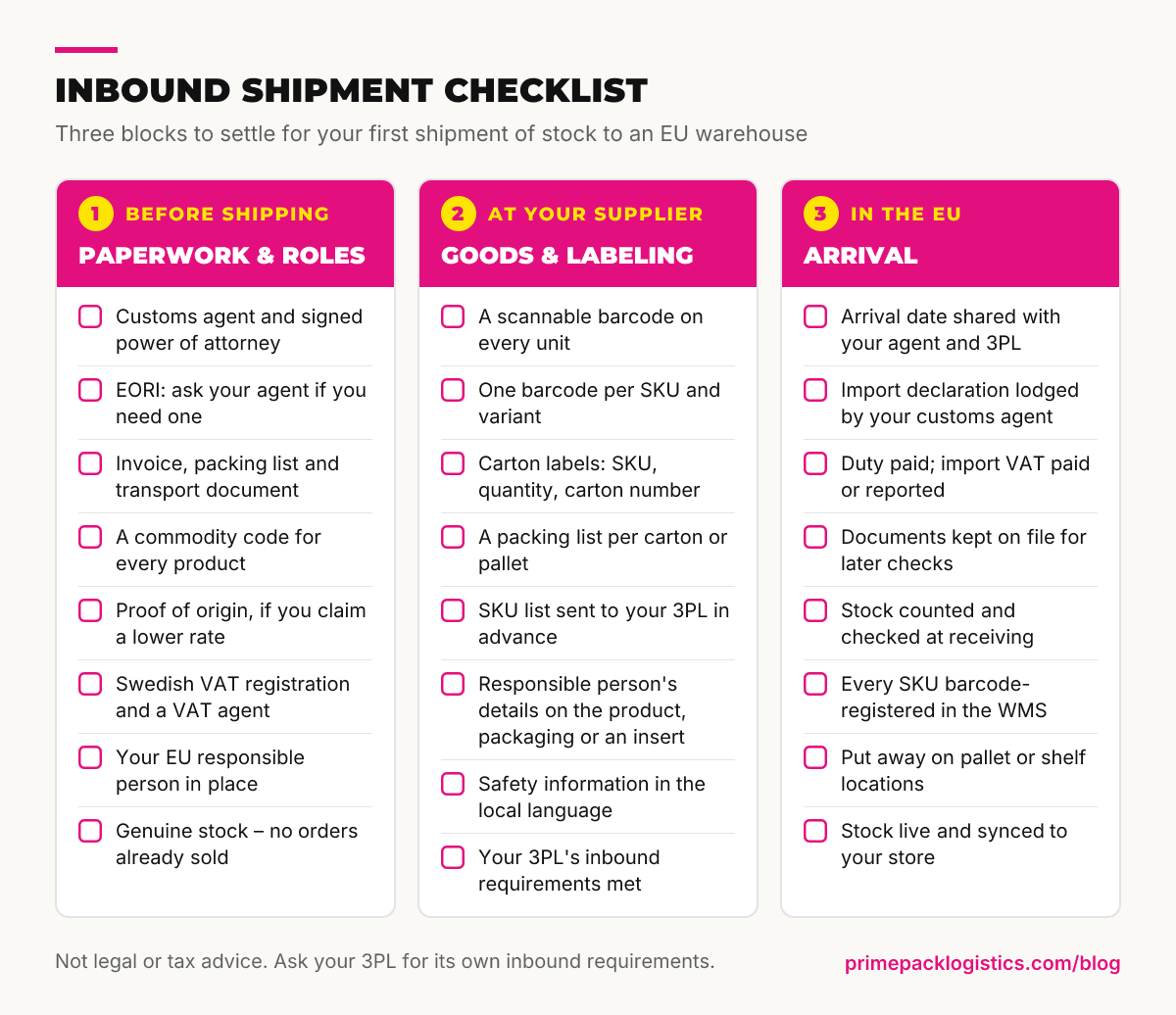
Which paperwork and roles must be in place before the goods ship?
A customs agent with a signed power of attorney, your shipment documents, a VAT setup and an EU responsible person for product safety. In more detail:
1. A customs agent and a power of attorney
Under the current EU customs rules, Swedish Customs states that a business established outside the EU cannot itself be the declarant on a customs declaration, apart from limited exceptions. So you either work with an EU-established customs agent that lodges the import declaration in its own name on your behalf (indirect representation), or have an EU-established company import the goods. Under indirect representation, both the agent and your brand can be held liable for the customs debt. Sign the power of attorney before the goods ship – our guide to freight forwarders, customs brokers and 3PLs explains who does what.
2. An answer on EORI
Don't assume you need an EORI number, the EU's customs ID for businesses. A business outside the EU needs its own only for certain customs activities in the EU, so your customs agent will tell you whether your setup needs one. If it does and your first such activity is in Sweden, you apply to Swedish Customs, free of charge. A GB EORI number is not valid for EU customs formalities. See our EORI guide for non-EU businesses.
3. Shipment documents and commodity codes
Your customs agent will typically ask for the commercial invoice, a packing list, the transport document (a bill of lading or air waybill) and the commodity code for each product. Some products also need licenses, permits or certificates. Describe your products accurately, too: carriers and, in some cases, other parties must file advance safety and security data for goods entering the EU. Not classified yet? Start with how to find the HS code for an EU import.
4. Proof of origin, if you claim a lower rate
Duty depends on each product's commodity code and its origin – where it was made, not where it ships from. A reduced or zero rate based on origin, for example under a trade agreement, applies only if the goods meet the origin rules and you have the right proof of origin.
5. A Swedish VAT registration – and a VAT agent
Selling to consumers in Sweden from stock held there normally means a Swedish VAT registration. Start early: if you are registered when the goods are cleared, you normally report the import VAT in your Swedish VAT return and deduct it there, to the extent you have a right to deduct, instead of paying it to Swedish Customs. Agree with your customs agent and tax advisor who acts as importer. Brands from the US, Canada, Australia or the UK should also plan for a VAT agent approved by the Swedish Tax Agency – optional only for businesses established in an EU or Nordic country. Our EU VAT guide for non-EU sellers covers the One Stop Shop for your other EU sales. We guide you through the setup and can put you in touch with accounting partners.
6. Your EU responsible person
Every brand based outside the EU needs its own EU responsible person for product safety – an EU importer or an authorized representative with a written mandate – in place before the goods ship. Their name, postal address and electronic address go on the product, its packaging, the parcel or an accompanying document, and in your online listings. The law has a fallback that puts the role on a fulfillment service provider, but only where there is no EU manufacturer, importer or authorized representative – don't rely on it. More in the EU responsible person under GPSR.
7. Genuine stock, not orders already sold
The bulk-import model holds only for genuine stock. Goods already sold to individual customers before they are imported are treated as distance sales, even if they ship in the same container. If part of the shipment is already sold, tell your customs agent and tax advisor before it leaves.
How should you label and pack inventory for a 3PL?
So the warehouse can identify, count and register every unit without guesswork. Requirements differ between warehouses, so ask your 3PL for its inbound requirements before your supplier packs anything. Typical points:
- Product barcodes. A scannable barcode on every unit, one per SKU, so each size and color variant gets its own. If your products already have barcodes, ask whether your 3PL can use them.
- Carton labels. SKU, quantity and a carton number, such as 3 of 40. Keep one SKU per carton where you can, and mark mixed cartons clearly.
- A packing list per carton or pallet that matches your commercial invoice.
- Your SKU list, in advance – SKU, product name and barcode for every item, so the products are set up before the goods arrive.
- EU labels and inserts. Your responsible person's details, plus instructions and safety information in a language consumers can easily understand, as decided by each EU country where you sell – in Sweden, for example, Swedish.
- Advance notice. When the shipment is due, how it is packed and whether anything needs special handling.
What happens when your shipment arrives?
It is cleared through customs, delivered to the warehouse, then counted, checked and registered before it goes on sale. We coordinate the customs clearance of your bulk shipment with our customs partners, who can lodge the import declaration on your behalf as your customs agent. Duty and import VAT are due when the shipment is cleared – once per bulk shipment, not per order. Keep the documents on file: Swedish Customs can ask to see them after the declaration.
In our warehouse in Gothenburg, your stock goes through quality checks at receiving, and every SKU is registered by barcode in Ongoing WMS before it is put away on pallet or shelf locations. With our Shopify integration, stock levels sync back to your store and orders flow in automatically. From then on, orders to EU customers involve no customs – see how EU fulfillment works, step by step.
FAQ
Do I need an EORI number to ship inventory to an EU warehouse?
Not automatically. Your customs agent will tell you whether your setup needs your own. A GB EORI number is not valid for EU customs formalities.
Can my 3PL be the importer of my goods?
Not by default. A non-EU brand typically works with an EU-established customs agent that declares on its behalf, or imports through an EU-established company.
Should I register for VAT before the first shipment arrives?
Ideally, yes. If you are VAT-registered in Sweden when the goods are cleared, you normally report the import VAT in your Swedish VAT return instead of paying it to Swedish Customs. Confirm the timing with your tax advisor.
Planning your first shipment to Sweden? Tell us what you are shipping and when, and we'll walk you through our inbound requirements.