In short
- A freight forwarder arranges the transport of your goods, while a customs broker – also called a customs agent, and in EU law a customs representative – lodges the import declaration when they arrive.
- A business established outside the EU generally can't be the declarant itself, so it typically works with an EU-established customs agent that declares in its own name on the brand's behalf, and both can be held liable for the customs debt.
- Stock in Sweden normally means a Swedish VAT registration, and brands from the US, Canada, Australia or the UK should plan for a VAT agent approved by the Swedish Tax Agency.
- Every brand based outside the EU needs its own EU responsible person for product safety – an EU importer or an authorized representative – in place before the goods ship.
- A 3PL receives, stores and ships your stock, but it doesn't replace any of these roles.
Most comparisons of customs broker vs freight forwarder are written for imports into the US. If you sell from the US, Canada, Australia or the UK and plan to keep stock in an EU warehouse, the question looks different. You will quickly run into five roles with overlapping names: a freight forwarder, a customs broker, a VAT agent, an EU responsible person and a 3PL. A mix-up can leave your goods waiting at the border while you look for someone who is allowed to declare them. It can also leave your products without the EU responsible person they need before they can be sold.
This guide answers the freight forwarder vs customs broker question for the EU and places the other roles around it. It ends with a role map you can share with your team and a checklist for your first shipment. It reflects EU rules as of September 2026 and uses Sweden, where our warehouse is, as the VAT example.
Freight forwarder vs customs broker: what's the difference?
A freight forwarder moves your goods; a customs broker declares them. The forwarder organizes the journey from your supplier to the EU. The customs broker lodges the import declaration that releases the goods into the EU. That declaration is a legal act, and it comes with legal liability.
What a freight forwarder does
A freight forwarder organizes your transport. For a bulk shipment into the EU, that typically means:
- booking space with carriers by sea, air, road or rail, and sharing a container with other cargo when you don't fill one yourself;
- arranging collection from your supplier or your own warehouse;
- issuing or collecting the transport document, such as a bill of lading or an air waybill, which your customs agent will need;
- tracking the shipment and arranging delivery to your EU warehouse after clearance.
A forwarder works for whoever books it: usually you, or your supplier if the supplier arranges transport. Its job ends at delivery. It does not own, sell or declare the goods unless it has also agreed to act as your customs agent.
What a customs broker does in the EU
A customs broker handles the formalities with the customs authority. For a bulk import into the EU, that mainly means the import declaration that releases your goods for free circulation. Around that declaration, your broker will typically:
- collect your shipment documents (listed further down);
- help confirm how your products are classified, which together with their origin decides the duty rate;
- declare the customs value and any preferential origin you claim;
- work out the duty and import VAT due, and answer questions from customs.
The two jobs meet at the customs value. Where the duty is a percentage, it is calculated on the customs value, which is generally the value of the goods plus shipping and insurance up to the EU border. So your broker may need the freight costs from your forwarder, not just your commercial invoice.
Why the two roles get confused
Some forwarders also offer customs clearance, either in-house or through a partner, and you may get one invoice for both. That is convenient, but the roles remain legally different. Booking transport creates no customs liability, but lodging an import declaration does. Under the EU's Union Customs Code, the declarant is liable for the customs debt. Under indirect representation, the business on whose behalf the declaration is made is liable too.
| What differs | Freight forwarder | Customs broker (customs agent) |
|---|---|---|
| Main job | Moves your goods from origin to destination | Declares your goods to EU customs on arrival |
| Works with | Carriers, ports, airports and warehouses | The customs authority in the EU country of import |
| Key documents | Bill of lading or air waybill, booking confirmations | The import declaration, built on your invoice, packing list, transport document and commodity codes |
| Liable for the customs debt? | Not for booking transport | Yes, as declarant. Under indirect representation, your business is liable too |
| Must be established in the EU? | Not for the role itself | Yes, as a rule, to lodge your import declaration |
| How you engage them | A booking or a freight contract | A power of attorney to act on your behalf |
What is a customs agent in the EU?
In EU law, a customs agent is called a customs representative: any person appointed by another person to carry out the acts and formalities required under customs law in their dealings with the customs authorities. “Customs broker” and “customs agent” are everyday names for the same job. The definition is in Article 5 of the Union Customs Code (Regulation (EU) No 952/2013), which sets the customs rules for all EU member states.
Direct or indirect representation?
The Union Customs Code allows two kinds of representation:
- Direct representation: the agent acts in your name and on your behalf, so your business is the declarant.
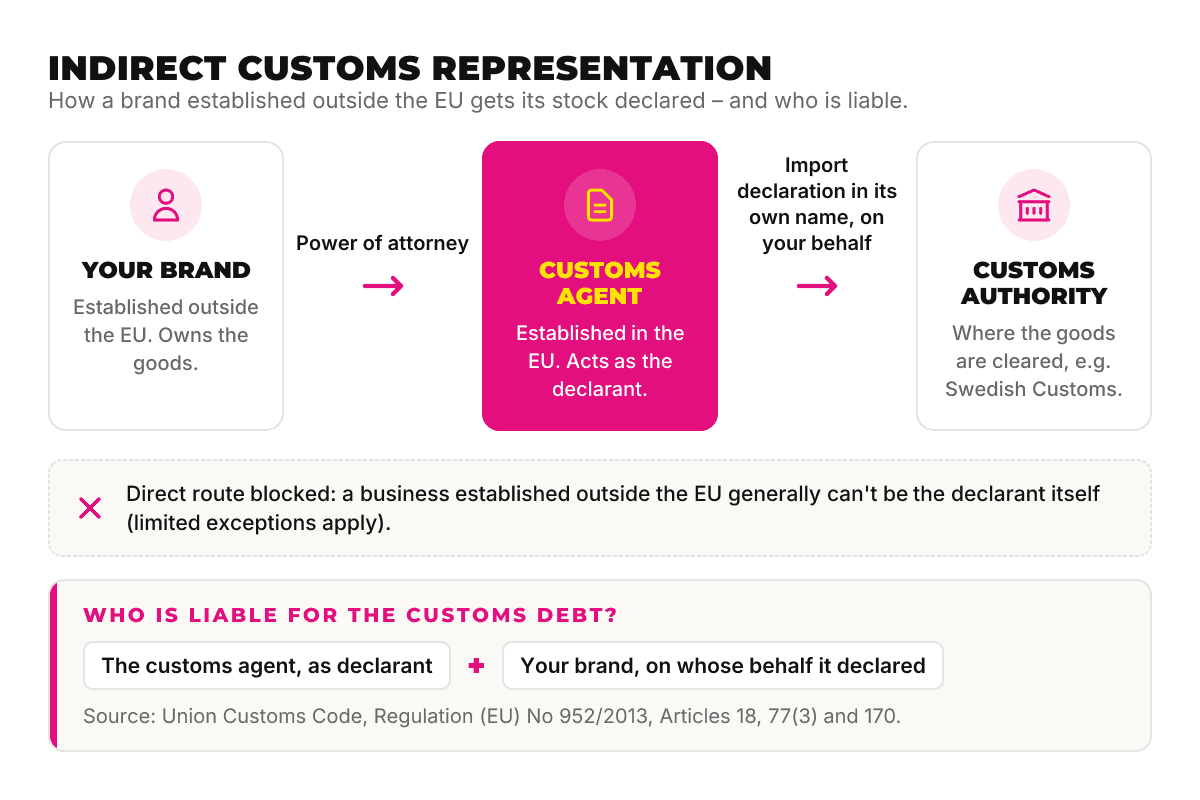
- Indirect representation: the agent acts in its own name but on your behalf, so the agent is the declarant.
For a brand established outside the EU, that difference decides the setup. Article 170 of the Code requires the declarant to be established in the EU, apart from limited exceptions such as transit. Under direct representation, the declaration is lodged in your name, which makes your brand the declarant, so on an ordinary import that route is generally closed. The next section covers the routes that work.
Does a customs broker in Europe need a license?
There is no single EU-wide broker license. The Union Customs Code requires a customs representative to be established in the EU, with limited exceptions, and lets each member state set the conditions under which representatives established there may provide services. A representative that meets the Code's criteria for authorized economic operators on compliance, record-keeping, financial solvency and professional competence is also entitled to offer its services in other member states. So check two things: that your agent is established in the EU, and that it can declare in the country where your goods are cleared. For stock heading to our warehouse in Gothenburg, that is normally Sweden.
How do you appoint a customs agent?
Your agent must tell customs that it acts on your behalf, and whether the representation is direct or indirect. Customs can ask for evidence that you gave it the authority to do so. In practice, that evidence is the power of attorney you sign before the goods leave your supplier.
Who can lodge an EU import declaration for a non-EU brand?
Under the current EU customs rules, Swedish Customs states that a business established outside the EU cannot itself be the declarant on a customs declaration, apart from limited exceptions. A non-EU brand therefore typically works with an EU-established customs agent that lodges the import declaration in its own name on the brand's behalf. The other route is for an EU-established company, for example one in the brand's own group, to import the goods.
Under indirect representation, both the agent and your brand can be held liable for the customs debt (Article 77(3) of the Union Customs Code). Agree on the setup and the power of attorney before the goods ship, not while they sit at the port.
Do you need your own EORI number?
Not automatically. A business outside the EU needs its own EORI number, the EU's customs ID for businesses, only if it carries out certain customs activities in the EU itself. Your customs agent will tell you whether your setup requires one. If it does, you apply in the EU country where that first activity takes place. In Sweden, that is Swedish Customs (Tullverket), free of charge.
A UK EORI number starting with GB is not valid for customs formalities in the EU. UK brands use it for the UK side of the shipment. Our guide to EORI numbers for non-EU businesses covers when you need one and how to apply.
What will your customs agent ask you for?
For a commercial bulk shipment into the EU, expect a request for:
- the commercial invoice;
- a packing list;
- the transport document, such as a bill of lading or an air waybill, which usually comes through your forwarder;
- the commodity code for each product;
- proof of origin, if you want to claim a reduced or zero duty rate under a trade agreement. For Canadian-made goods, see what counts as proof of origin under CETA;
- any licenses, permits or certificates your product needs.
Keep them on file after clearance, because Swedish Customs can ask to see supporting documents after the declaration. Share accurate product descriptions early, too: carriers, and in some cases other parties in the supply chain, must file advance safety and security data for goods entering the EU.
Bulk stock or single parcels: which rules apply?
Everything above applies to stock imported in bulk and cleared before it is sold. Low-value parcels sent one by one to EU consumers from outside the EU follow separate, temporary rules. Since 1 July 2026, parcels worth up to €150 pay a flat customs duty of €3 per item type, whichever VAT scheme is used, planned until 1 July 2028. Our explainer on the EU's €3 customs duty goes through what counts as an item type.
An EU customs reform adopted in September 2026 will also, over the coming years, make non-EU online sellers and platforms responsible, as importers, for customs on goods they sell directly to EU consumers. Genuine stock imported in bulk and cleared before it is sold follows the normal rules instead. Goods already sold to individual customers before import don't count as stock, even if they ship together.
Where does a 3PL fit, and what can't it do?
A 3PL (third-party logistics provider) takes over once your goods are in the EU. It receives and checks your stock, stores it, picks and packs orders, ships them and handles returns. It does not replace your customs agent, VAT agent or EU responsible person. Those are legal roles with their own requirements.
Freight forwarder vs 3PL
A forwarder moves goods between places, while a 3PL keeps goods in one place and turns them into orders. The forwarder's job for your bulk shipment ends at the warehouse door. The 3PL's job starts there and repeats with every order:
- Forwarder: one job per shipment, covering collection, transport and delivery to the warehouse.
- 3PL: ongoing work, covering receiving, storage, pick and pack, shipping each order, returns and stock reporting.
Some companies offer both kinds of service, so when you compare quotes, compare the jobs rather than the company labels.
Why returns belong in the 3PL conversation
Once your stock is cleared, orders go to customers in other EU countries with no customs on the way, although VAT still applies to each sale. Returns come back the same way, to be received, inspected and restocked. They deserve extra attention now that EU countries must apply the rules on an online withdrawal function from 19 June 2026. Our guide to the EU withdrawal button follows a return from the click to the parcel. For the full list of warehouse work, see our European 3PL services.
What a 3PL is not
By default, a 3PL is not your importer, declarant, VAT agent or EU responsible person, and neither is a forwarder or a marketplace service. If a provider does take on one of those roles, get it in writing and make sure you understand what it means for liability.
Where Primepack fits
We are a 3PL in Hisings Kärra, Gothenburg, near the Port of Gothenburg, Sweden's largest port, which handles more than half of Sweden's container traffic. We are not the importer, the declarant, the VAT agent or the responsible person. We coordinate the customs clearance of your bulk shipment with our customs partners, who can lodge the import declaration on your behalf as your customs agent. Read more about who clears your stock through EU customs. For VAT, we guide you through the setup and can put you in touch with accounting partners.
Who handles VAT: a VAT agent, an accountant or a tax advisor?
In Sweden, up to three parties handle your VAT, each with a different job. A VAT agent approved by the Swedish Tax Agency reports VAT on your behalf. An accountant keeps your books and prepares your returns. A tax advisor confirms that your setup is right for your business. One firm can sometimes do more than one of these jobs, as long as it meets the requirements for each.
Why stock in Sweden means Swedish VAT
If your business is based outside the EU and sells to consumers in Sweden from stock held there, those are Swedish sales. You will normally need to register for VAT in Sweden and charge Swedish VAT. A Swedish VAT registration is also what normally lets you report and deduct the import VAT on your inbound stock. Sweden's small-business VAT exemption does not apply to businesses based outside the EU.
Sales to consumers in other EU countries can go through the One Stop Shop (Union scheme), which you register for in Sweden with your Swedish VAT number, charging each customer's national VAT rate. The €10,000 distance-selling threshold doesn't apply to businesses established outside the EU, so as a rule the customer's VAT applies from the first sale. Your Swedish sales stay in your Swedish VAT return.
The Swedish VAT agent (ombud)
Sweden requires a business that is not established in Sweden and owes Swedish VAT to be represented by a VAT agent (ombud) approved by the Swedish Tax Agency (Skatteverket), unless an exception applies. The rule is in chapter 6, section 2 of the Swedish Tax Procedure Act. Skatteverket's guidance says appointing an agent is optional for businesses from other EU or Nordic countries. A brand from the US, Canada, Australia or the UK is neither, so plan for the requirement and confirm it with Skatteverket or a tax advisor.
According to Skatteverket:
- the agent must be established in Sweden, and a private individual is normally approved only if they live in Sweden;
- the agent reports VAT on your behalf and represents you in VAT matters in Sweden;
- you appoint the agent with form SKV 5703, or with a document showing that the agent will be responsible for reporting VAT on your behalf.
Our VAT guide goes deeper into the question do you need a VAT agent in Sweden?
Is a VAT agent the same as a fiscal representative?
Not necessarily. “Fiscal representative” is a common name for what the EU VAT Directive calls a tax representative. Under Article 204, member states may let, and in some cases require, a non-established business appoint a tax representative “as the person liable for payment of the VAT”. Swedish law is worded differently. It requires the business to be represented by an agent that Skatteverket approves, and Skatteverket describes the agent's job as reporting VAT and representing you. So don't assume that a fiscal representative from another EU country covers Sweden, or that the Swedish role works the same way. Ask your tax advisor what the agent is responsible for, including any liability for the VAT.
Who reports the import VAT on your stock?
Import VAT is normally due in the EU country where the goods are cleared through customs. If they are cleared in Sweden and the importing business is VAT-registered in Sweden at the time of the customs decision, it normally reports the import VAT in its Swedish VAT return and deducts it there, to the extent it has a right to deduct. A business that is not VAT-registered in Sweden pays import VAT to Swedish Customs instead.
So your customs agent, VAT agent and tax advisor have to agree on who acts as importer, and on whether that business is registered in time for the first clearance.
Do marketplaces change who handles VAT?
They can. On sales within the EU by businesses established outside the EU, an online marketplace may be treated as the seller for VAT purposes and account for that VAT itself. On your own webshop, the VAT is yours to handle.
Who is your EU responsible person for product safety?
Your EU responsible person is an economic operator established in the EU that is responsible for your product under the EU's General Product Safety Regulation (GPSR). For a brand based outside the EU, that can be an EU importer or an authorized representative appointed by written mandate. Under the GPSR (Regulation (EU) 2023/988), a consumer product can only be placed on the EU market if such an operator is responsible for it.
EU rules set out who acts as a product's EU responsible person:
- a manufacturer established in the EU;
- an importer established in the EU;
- an authorized representative with a written mandate from the manufacturer.
Only where none of these is established in the EU does the role fall, by law, on an EU fulfillment service provider for the products it handles. A brand based outside the EU should therefore have its own EU responsible person in place before its products are placed on the EU market. In practice, that means before the goods are shipped to the EU.
The responsible person's name and contact details, including a postal and an electronic address, must appear on the product, its packaging, the parcel or an accompanying document. Each online product offer to EU consumers must show them too.
Is your customs agent also your EU importer?
Don't assume so, because customs law and product-safety law are separate. The GPSR defines an importer as a person established in the EU who places a product from a non-EU country on the EU market. The customs declarant is a different concept, defined in the Union Customs Code. Decide who your responsible person is and get it in writing. Then put their details on your labels before the goods leave your supplier, so the stock arrives ready to sell.
The role map: who does what when you stock inventory in the EU
Seven roles cover the journey from your supplier to your customer. Four of them move, clear or handle the goods: the forwarder, the customs agent, the 3PL and the parcel carrier. Three sit alongside them for VAT and product safety: the VAT agent, the tax advisor and the EU responsible person. You, as the brand, are the one who puts them all in place.
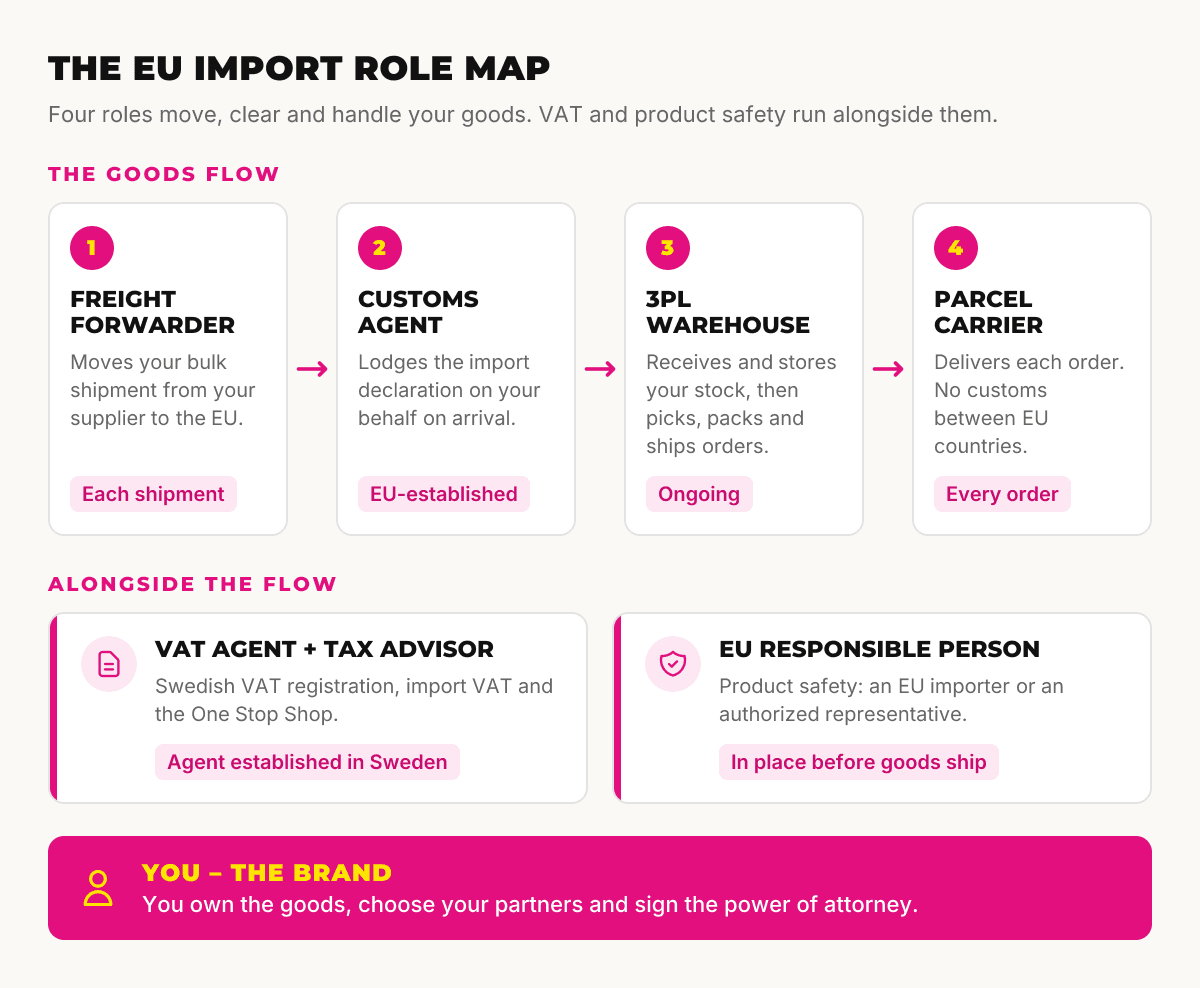
| Role | What they do | Must be EU-established? | Who hires them | When you need them |
|---|---|---|---|---|
| Freight forwarder | Books and manages the transport of your bulk shipment to the EU warehouse, including the transport document | Not for the role itself | You, or your supplier if you agreed that it arranges transport | Every inbound shipment |
| Customs agent (customs broker; in EU law, customs representative) | Lodges the import declaration, usually in its own name on your behalf (indirect representation) | Yes, as a rule | You, by power of attorney. A forwarder or 3PL may coordinate it | Every import into the EU |
| VAT agent (ombud) | Reports Swedish VAT on your behalf and represents you in VAT matters | Yes, established in Sweden | You, with Skatteverket's approval | From your Swedish VAT registration, if you are based in the US, Canada, Australia or the UK |
| Tax advisor or accountant | Confirms your VAT setup, keeps your books and prepares the Swedish VAT and One Stop Shop returns | No legal requirement | You | Before your first shipment, then every return period |
| EU responsible person (GPSR) | Is responsible for your products' safety in the EU; its name and addresses appear on the product, packaging, parcel or document and in your listings | Yes | You: an EU importer, or an authorized representative by written mandate | Before the goods ship to the EU |
| 3PL (fulfillment warehouse) | Receives, stores, picks, packs and ships your orders, and handles returns | Not required; it is wherever your stock is | You | From the first delivery, then with every order |
| Parcel carrier | Delivers each order to your customer | No requirement; orders inside the EU involve no customs | Usually booked through your 3PL | Every order |
Two roles in this table can't be left to whoever happens to be closest to the goods: the customs declarant and the EU responsible person. Both carry legal responsibility, and both need to be settled in writing before your goods move.
Which roles must be in place before your first shipment?
Four roles must be in place before the goods leave your supplier: your EU responsible person, your VAT agent and tax advisor, your customs agent with a signed power of attorney, and your forwarder. Your shipment documents and your 3PL need to be ready too, which makes six things to settle. Start with the responsible person, because your labels depend on it.
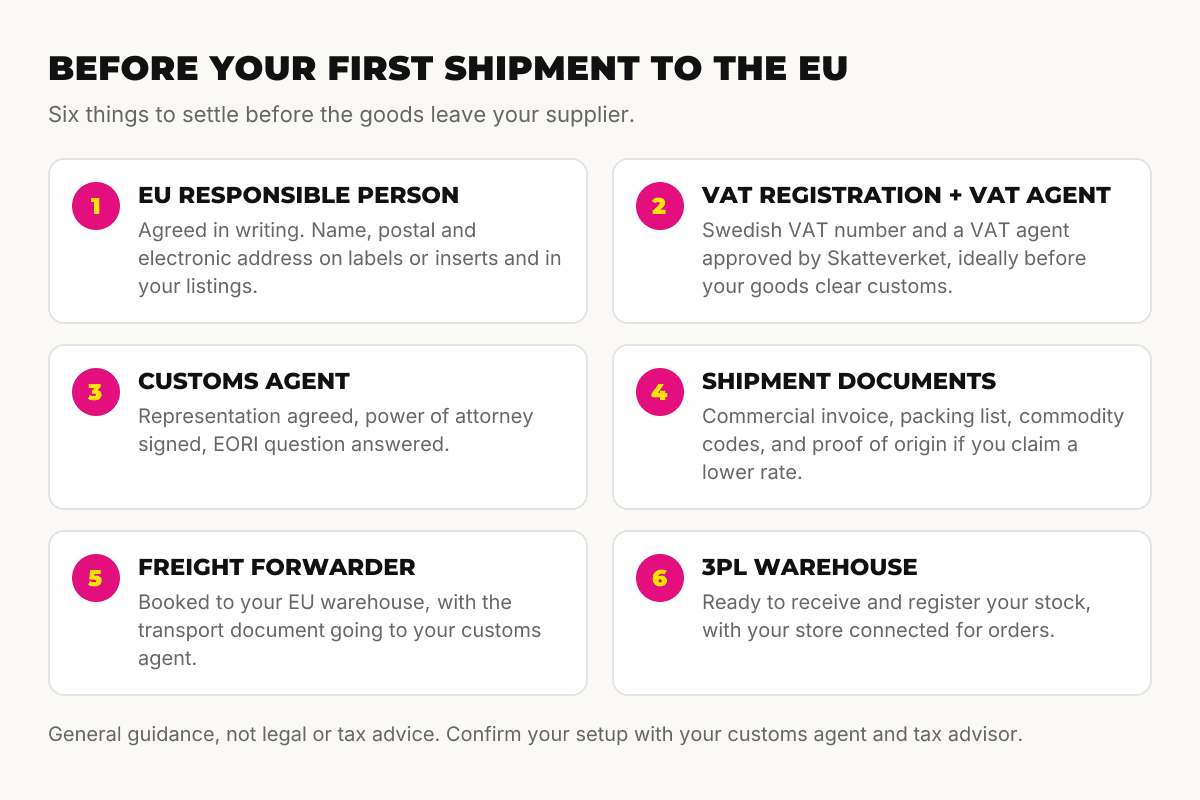
- EU responsible person. Appoint an authorized representative by written mandate, or identify your EU importer, and get their details onto labels or inserts and into your listings.
- Tax advisor and VAT setup. Arrange a Swedish VAT registration and, if you are based in the US, Canada, Australia or the UK, a VAT agent approved by Skatteverket. Aim to be registered before the customs decision on your first shipment.
- Customs agent. Agree on indirect representation, or on the EU-company route, and sign the power of attorney. Ask whether your setup needs your own EORI number.
- Shipment documents. Prepare the commercial invoice, the packing list and a commodity code for every product, plus proof of origin if you claim a preferential rate.
- Freight forwarder. Book the shipment to your EU warehouse's address, and make sure the transport document reaches your customs agent.
- 3PL. Set up your products so the stock can be received and barcode-registered on arrival, and connect your store so orders flow in.
For the full sequence from bulk shipment to first order, see how EU fulfillment works, step by step.
FAQ
Is a customs broker the same as a freight forwarder?
No. A freight forwarder arranges transport, while a customs broker declares goods to customs and, as declarant, is liable for the customs debt. Some companies offer both services, but they remain separate jobs.
Do I need a customs broker to import into the EU?
If your business is established outside the EU, in practice yes, unless an EU-established company imports the goods instead. Apart from limited exceptions, you can't be the declarant yourself.
Is a customs agent the same as a fiscal representative?
No. A customs agent handles customs formalities under the Union Customs Code. A fiscal (tax) representative is a VAT role. In Sweden, the requirement you will meet is a VAT agent approved by Skatteverket.
Is a UK (GB) EORI number valid in the EU?
No. An EORI number issued by the UK, starting with GB, is not valid for customs formalities in the EU. UK brands use it for the UK side of the shipment only.
Who pays the import duty when a customs agent declares for me?
Under the Union Customs Code, the declarant is the debtor. Under indirect representation, the business on whose behalf the declaration is made is also a debtor. Agree in advance with your agent and tax advisor how duty and import VAT will be paid and reported.
Do I need a freight forwarder if I use a 3PL?
You need someone to move your bulk shipment to the warehouse. That can be your own forwarder or your supplier's. A 3PL receives, stores and ships your stock, and the long-distance transport is a separate job.
Planning your first bulk shipment to Sweden? Tell us what you sell and where it's made, and we'll walk you through who does what for your products.