In short
- Since 19 June 2026, EU law requires stores that sell through a website or app to offer an online withdrawal function, labeled “withdraw from contract here” or an unambiguous equivalent.
- The customer fills in a short withdrawal statement, clicks a separate “confirm withdrawal” button and must receive an acknowledgement on a durable medium, such as email, with the content, date and time.
- Whether the rules reach a store outside the EU turns mainly on whether it directs its activities to EU consumers – confirm your own position with counsel.
- After the click, you have 14 days to refund and the customer has 14 days to send the goods back, and the refund can fall due before a cross-border return has even arrived.
- Where the parcel goes – back across a customs border or into stock you already hold in the EU – decides what a withdrawal really costs you.
The EU withdrawal button is the online withdrawal function that EU consumer law has required since 19 June 2026 for purchases made through a website or an app. It doesn't create a new right – EU consumers who buy online have had 14 days to withdraw without giving a reason under the Consumer Rights Directive since June 2014. What changed is how easy that right has to be to use. This guide covers the requirements, whether they reach a store outside the EU, and what physically happens to the return after the click.
What is the EU withdrawal button?
The EU withdrawal button is a button or link on an online store – labeled “withdraw from contract here” or an unambiguous equivalent – that lets a consumer exercise the 14-day right of withdrawal online and get an acknowledgement back. It comes from Article 11a of the Consumer Rights Directive (2011/83/EU), which EU countries have applied since 19 June 2026.
Article 11a was added by Directive (EU) 2023/2673. Most of that directive deals with financial services sold at a distance, so from an e-commerce point of view it is easy to overlook. But recital 37 says the withdrawal function should apply not only to financial services but also to distance contracts for other goods and services where EU law provides a right of withdrawal – an ordinary online order for a sweater included. EU countries had to adopt their national rules by 19 December 2025 and apply them from 19 June 2026.
Which sales need a withdrawal function?
Distance contracts with EU consumers concluded “by the means of an online interface”, such as a website or an app, where the right of withdrawal applies. Article 11a(1) says the trader “shall ensure that the consumer can also withdraw from the contract by using a withdrawal function”. Note the word also: under Article 11, customers can still use the model withdrawal form or any other unequivocal statement, such as an email. The button is an extra route, not the only one.
Withdrawal, return or faulty item?
The button is for the legal act of withdrawing – the customer changing their mind. The physical return follows from it, and a faulty item is a different claim altogether.
| Reason | What it is | Time limit |
|---|---|---|
| Withdrawal (change of mind) | The consumer cancels the contract without giving a reason. This is what the button is for. | 14 days, normally counted from delivery |
| Faulty item (legal guarantee) | The goods don't match the contract: repair or replacement, or failing that a full or partial refund, under the EU guarantee rules. | At least 2 years from receiving the goods, according to Your Europe |
| Your own returns policy | Anything you offer beyond the law, such as a 30-day window. The directive lets traders offer more than it requires. | Whatever you promise |
Does the EU withdrawal button apply to stores outside the EU?
It can. Whether it does turns mainly on whether you direct your activities to consumers in EU countries, and your own answer should come from counsel, not a blog post. EU consumer rules don't apply to a store just because EU residents can visit its website – but they don't stop at the EU border either.
How EU consumer law reaches a store abroad
The mechanism is the Rome I Regulation. Under its Article 6, a consumer contract is governed by the law of the country where the consumer lives if the business pursues its activities there or “by any means, directs such activities to that country”, and the contract falls within those activities. A choice-of-law clause in your terms can't deprive the consumer of the protection of rules that can't be waived in their own country (Article 6(2)). The Consumer Rights Directive points the same way: under recital 58, where a third country's law governs the contract, Rome I decides whether the consumer keeps the directive's protection, and Article 25 makes terms that waive or restrict those rights non-binding on the consumer.
What counts as directing your activities to the EU?
Rome I gives no checklist. Its recital 24 quotes a joint Council and Commission statement: a website being accessible isn't enough, although a factor will be that it solicits distance contracts and that a contract has actually been concluded at a distance. A store that offers delivery to EU countries and takes EU orders is in a very different position from one that doesn't ship to Europe at all. Where your store falls is a legal assessment – take it to counsel with the facts of how you market and deliver.
Platforms take a broad view. Shopify's Help Center says the directive applies to businesses selling online to EU consumers “regardless of where the business is located”. That is a platform's reading, not a court ruling. If your inventory already sits in an EU warehouse and ships to EU customers, plan on the rules applying to those sales and have counsel confirm it.
Does the EU withdrawal button apply to UK stores?
The directive is addressed to the EU member states, and the UK left the EU before it was adopted in November 2023. For a UK brand, the question is the same as for a US brand: do you sell to consumers in EU countries? If you do, this guide is relevant to your EU orders. UK consumer law for your UK customers is a separate matter.
What must the EU withdrawal function include?
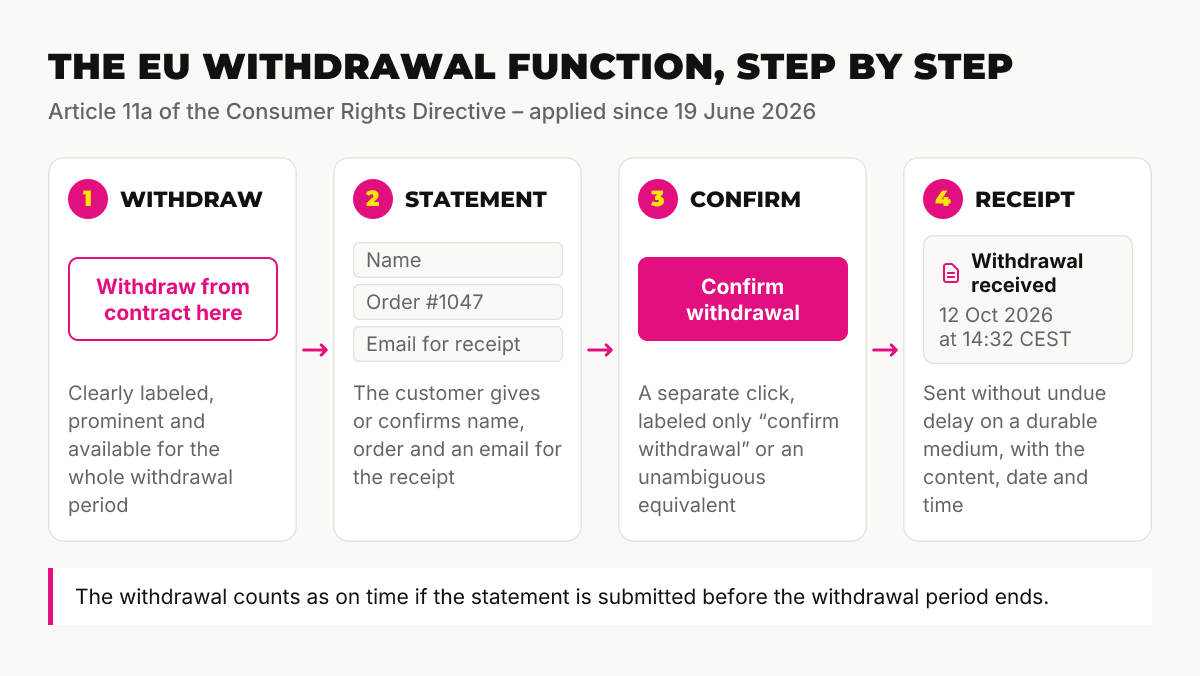
Four elements: a clearly labeled withdrawal button, an online withdrawal statement, a separate confirmation step and an acknowledgement of receipt on a durable medium. The function must also be prominent, easy to reach and available for the whole withdrawal period. These are the EU right of withdrawal requirements for the button itself.
1. The button: “withdraw from contract here”
The label must be “withdraw from contract here” or an unambiguous corresponding formulation, easily legible. The function must be “continuously available throughout the withdrawal period” and “prominently displayed on the online interface and easily accessible to the consumer”. Recital 37 adds that customers shouldn't have to go through procedures to reach it, such as downloading an app they didn't buy through, and that a hyperlink to the function helps.
A German, French or Swedish storefront should use an unambiguous label in that language. The directive is published in every official EU language, and Article 6(7) of the Consumer Rights Directive lets EU countries set language requirements for contract information – check the wording for each market.
2. The online withdrawal statement
The button opens a withdrawal statement in which the customer can easily provide or confirm their name, details identifying the contract (in practice, the order) and the electronic address for the confirmation (Article 11a(2)). Recital 37 says a customer who is already identified, for example by logging in, shouldn't have to identify themselves or the contract again – so prefill the form. It also says you can let customers withdraw from part of a multi-item order – in practice, an item picker rather than an all-or-nothing form.
3. The confirmation step: “confirm withdrawal”
The customer submits the statement through a confirmation function labeled “only with the words ‘confirm withdrawal’ or with an unambiguous corresponding formulation” (Article 11a(3)). Its purpose is to prevent accidental withdrawals. The overall aim, in recital 37, is that consumers can withdraw from a contract just as easily as they concluded it – a confirmation step that turns into an obstacle course works against that.
4. The acknowledgement on a durable medium
You must then send an acknowledgement of receipt “on a durable medium, including its content and the date and time of its submission, without undue delay” (Article 11a(4)). A durable medium lets the customer store the information and reproduce it unchanged (Article 2(10)); the directive's model withdrawal instructions give email as the example. The withdrawal counts as on time if the statement was submitted before the period expired (Article 11a(5)), so that timestamp is the record that settles any dispute about lateness.
Update your withdrawal information too
The information you give before the purchase must now cover, where applicable, the existence and placement of the withdrawal function (Article 6(1)(h), as amended), and the model withdrawal instructions in Annex I gained a matching sentence. Under Article 10, if the withdrawal information that Article 6(1)(h) requires isn't given, the withdrawal period can run up to 12 months longer – so treat the new sentence as part of that information, not as an optional extra.
| Element | What the directive requires | What to check in your store |
|---|---|---|
| The button | Labeled “withdraw from contract here” or an unambiguous equivalent; easily legible, prominent, easy to access | The label in every storefront language, and where the link sits on mobile and desktop |
| Availability | Continuously available throughout the withdrawal period | It works from the order until the period ends, and guest customers can reach it |
| Withdrawal statement | The customer can easily provide or confirm their name, the contract and an electronic address for the confirmation | Fields prefilled for signed-in customers, and an item picker for partial withdrawals |
| Confirmation | A separate function labeled only “confirm withdrawal” or an unambiguous equivalent | The button text, and whether anything stands between statement and confirmation |
| Acknowledgement | Sent without undue delay on a durable medium, with the content and the date and time of submission | An automatic email with the items, the order number and a timestamp |
| Pre-contract information | Where applicable, the existence and placement of the withdrawal function | Your withdrawal policy, checkout information and order confirmation |
What does an EU withdrawal button look like? An example
A link labeled “Withdraw from contract here” that opens a short, prefilled form, a single “Confirm withdrawal” button, and an email receipt with the date and time. Here is a typical EU withdrawal button example, seen from the customer's side:
- Finding it. On the order status page – reached from the shipping confirmation or the customer account – a link reads “Withdraw from contract here”. The same link sits in the store footer for guest customers.
- Filling in. The form shows the name, order #1047 and the email on the order, all editable, with a checkbox for each item.
- Confirming. One clearly labeled button: “Confirm withdrawal”.
- Receipt. An email arrives with the content of the statement and the date and time it was submitted.
The receipt does double duty: it is the legal acknowledgement, and the natural place to tell the customer where to send the goods, by when and at whose cost.
Which products are exempt from the EU right of withdrawal?
Article 16 of the Consumer Rights Directive lists 13 exceptions. For physical products, the main ones are personalized or made-to-order goods, goods that spoil quickly, sealed hygiene goods once unsealed, goods inseparably mixed with other items, and sealed media or software once unsealed. The full list, from the consolidated Consumer Rights Directive (including the points reworded by Directive (EU) 2019/2161):
| Point | Exception | What it means for an online store |
|---|---|---|
| (a) | Services fully performed – if the consumer pays, only where they gave prior express consent and acknowledged losing the right | Relevant if you sell a service, such as installation, alongside a product |
| (b) | Goods or services priced by financial-market fluctuations the trader can't control | Rare in e-commerce |
| (c) | Goods made to the consumer's specifications or clearly personalized | Engraved or made-to-measure items. Article 2(4) covers non-prefabricated goods made on the consumer's individual choice – a stock size or color doesn't count |
| (d) | Goods liable to deteriorate or expire rapidly | Food or drinks with a short use-by date |
| (e) | Sealed goods unsuitable for return for health or hygiene reasons, unsealed after delivery | Only once the seal is broken – an unopened item can still be withdrawn from |
| (f) | Goods inseparably mixed with other items after delivery, by their nature | Uncommon in parcel e-commerce |
| (g) | Alcohol priced at sale, deliverable only after 30 days, with a market-dependent value | All three conditions must apply – not an ordinary wine order |
| (h) | Urgent repairs or maintenance at a visit the consumer requested | Extra goods or services beyond the request stay withdrawable |
| (i) | Sealed audio, video or computer software, unsealed after delivery | A boxed game or film once the seal is broken |
| (j) | Newspapers, periodicals or magazines | Single issues only – subscriptions are not exempt |
| (k) | Contracts concluded at a public auction | A sale consumers can attend in person, run by an auctioneer (Article 2(13)) |
| (l) | Accommodation (not residential), transport of goods, car rental, catering or leisure services for a specific date or period | Event tickets, hotel stays or car rental for fixed dates |
| (m) | Digital content not on a tangible medium, once performance has begun – if the consumer pays, only with prior consent, acknowledgement of losing the right and the trader's confirmation | Downloads or streams the customer asked to start right away |
Three things to know about the exceptions
- Say so before the purchase. Under Article 6(1)(k), the customer must be told before they are bound if an item has no right of withdrawal or can lose it – in practice, somewhere they will see it before ordering, such as the product page and checkout.
- Mixed orders still need the button. An order with one engraved bracelet and two standard ones keeps a right of withdrawal for the standard items.
- An exception covers a change of mind, not a fault. A personalized item that arrives damaged is still a guarantee matter.
How do you add an EU withdrawal button to a Shopify store?
Shopify's Help Center points merchants to its self-serve return and cancellation settings, reached through customer accounts and a visible link in the store – and says plainly that “using these tools doesn't automatically make your store compliant”. On any platform, configure what it offers, then check the finished flow against Article 11a.
Under “Meeting EU right of withdrawal requirements” in its return rules documentation, Shopify tells merchants to turn on self-serve returns and cancellations, accept both kinds of request, set a return window of at least 14 days starting at delivery of the last item, and add a visible link, for example a menu item, so customers can reach both actions. The guidance doesn't settle the wording of that link, so check it yourself: “Withdraw from contract here”, or an unambiguous equivalent in each storefront language. On another platform, the same checks apply – whether the function comes from your platform, your theme or an app.
If you are weighing stock in Europe, our page on Shopify fulfillment in Europe explains how orders, stock levels and tracking flow between your store and an EU warehouse.
What happens after the click? Refund deadline and return costs
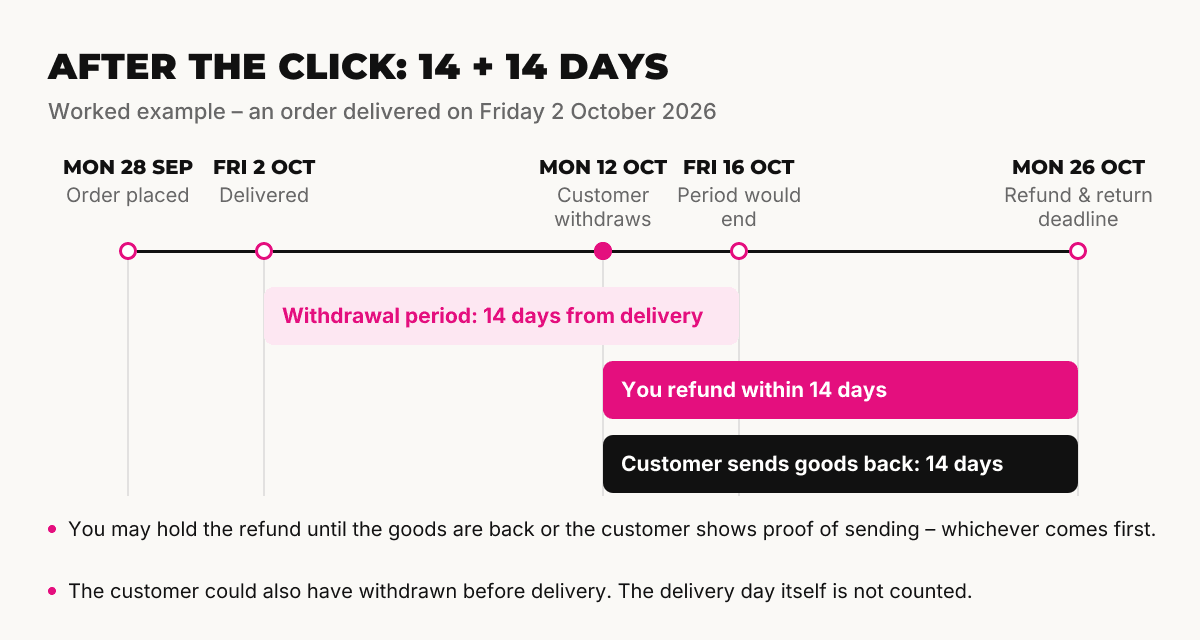
Once a customer withdraws, you have 14 days to refund everything they paid, including standard delivery, and they have 14 days to send the goods back. You may hold the refund until you have the goods back or proof that they were sent – whichever comes first.
The refund: 14 days, same payment method
You must reimburse all payments, including delivery, “without undue delay and in any event not later than 14 days” from the day you are informed of the withdrawal, using the customer's original means of payment unless they agree otherwise at no cost to them (Article 13(1)). If they chose a delivery option dearer than your least expensive standard delivery, you don't refund the difference (Article 13(2)).
The goods: 14 days to send them back
Unless you offered to collect the goods, the customer must send them back no later than 14 days after withdrawing. Sending them within that time is enough; the parcel doesn't have to arrive by then (Article 14(1)).
Who pays for return shipping?
The customer pays the direct cost of the return – but only if you told them before the purchase. Otherwise, the cost is yours (Articles 6(1)(i), 6(6) and 14(1)). For goods that can't normally go back by post, you must also state the return cost. For a store outside the EU, that sentence decides who pays for an international return label, so write it with your real return route in mind.
Why the refund can come before the parcel
Article 13(3) lets you withhold the refund until the goods are back “or until the consumer has supplied evidence of having sent back the goods, whichever is the earliest”. A customer in Germany posting a return to Ohio can show proof of postage the same day, while the parcel still has an international journey and a customs border ahead of it. Once they have, you can no longer hold the refund back for the parcel.
Inspection still matters. The customer is liable for diminished value caused by handling the goods beyond what is needed to establish their nature, characteristics and functioning (Article 14(2)) – which only helps if someone inspects the item and records its condition. That liability falls away if you didn't inform the customer about the right of withdrawal.
| Step | Who | Deadline | Where it's set |
|---|---|---|---|
| Acknowledge the withdrawal | You | Without undue delay | Article 11a(4) |
| Refund all payments, including standard delivery | You | No later than 14 days after you are informed | Article 13(1)–(2) |
| Hold the refund (optional) | You | Until the goods are back or proof of sending is shown – whichever comes first | Article 13(3) |
| Send the goods back | Customer | No later than 14 days after withdrawing; sending in time is enough | Article 14(1) |
| Pay the direct cost of the return | Customer – only if told before the purchase | – | Articles 6(1)(i), 6(6), 14(1) |
| Cover diminished value from excessive handling | Customer | – | Article 14(2) |
Where does the returned parcel go?
One of three places: back across a customs border to your home warehouse, to a return address inside the EU, or into stock you already hold in the EU. That choice decides how far the item travels, whether it crosses customs and how soon it can be sold again to your next EU customer.

Back to the US, Canada or Australia
The return is a new international shipment. It leaves the EU and enters your home country's customs territory, so it needs customs paperwork, and whether you pay duty or import taxes on your own returned goods depends on your country's rules – a question for your customs broker. Our guide to the difference between a freight forwarder and a customs broker explains who handles what. Meanwhile, the refund clock runs on EU rules. For brands on the far side of the world, see EU fulfillment for Australian brands.
Back to the UK
Great Britain is outside the EU customs union. An item that was cleared into the EU on its way to the customer has to cross a customs border again when it goes back to a warehouse in Great Britain – this time out of the EU and into Great Britain. Our page for UK brands explains why UK returns cross the border twice.
To an EU return address
A return address inside the EU keeps the trip short, with no customs inside the EU. But the item still needs a next step: unless someone there inspects it and puts it back on sale, it has to be sent on – home in batches, which brings the customs crossing back – or disposed of. Ask who inspects each item, how quickly they report and what happens next.
Into your EU stock
If your inventory is already in the EU, the return goes back to where your EU orders ship from. At Primepack in Gothenburg, Sweden, returns from EU customers are received, inspected and restocked, with no customs inside the EU on the way back. Read how EU returns handling works in our warehouse, and see how returns are priced – per DTC return, on its own line.
EU stock changes the outbound side too. Orders shipped from stock that was imported in bulk and cleared before it was sold aren't imports, so the temporary €3 customs duty on low-value parcels doesn't apply to them – see what the EU's €3 customs duty covers. The trade-off is setup: a bulk import, a VAT registration and a 3PL, as our overview of EU fulfillment for brands outside the EU explains.
| Question | Home warehouse outside the EU | EU return address only | EU stock at a 3PL |
|---|---|---|---|
| Customs on the way back? | Yes – the parcel leaves the EU | No | No |
| Inspection vs. refund | Proof of sending can end your right to hold the refund long before the item arrives | Depends on who receives the item and how fast they report | Received and inspected where the stock is held |
| Back on sale in the EU? | Only if shipped to Europe again | Only if someone restocks it or sends it on | Yes – restocked with the stock your EU orders ship from |
| What you set up | International return labels and customs paperwork | A receiving partner and a plan for each item | Stock imported in bulk, a VAT registration and a 3PL |
FAQ
Is the EU withdrawal button required?
Yes. Since 19 June 2026, stores selling to EU consumers through a website or an app must offer an online withdrawal function for contracts that carry a right of withdrawal. Whether that reaches a store based outside the EU depends mainly on whether it directs its activities to EU consumers.
Do I have to use the exact words “withdraw from contract here”?
No. Article 11a allows an unambiguous corresponding formulation, for the button and for “confirm withdrawal”. The closer you stay to the directive's wording, in each storefront language, the less room for argument.
How long is the EU withdrawal period?
14 days, counted from the day after the goods are delivered – or after the last item arrives, if one order comes in several deliveries. If the last day is a Saturday, Sunday or public holiday, the period runs to the end of the next working day.
Does the button replace other ways to withdraw?
No. Customers can still use the model withdrawal form or any other unequivocal statement, such as an email (Article 11). The button is an additional route.
Can I charge customers for return shipping?
Yes, for the direct cost of the return – if you told them before the purchase. If you didn't, you pay. Faulty items fall under the legal guarantee instead.
Can I wait until the item arrives before I refund?
Only until the item arrives or the customer shows proof of sending it, whichever comes first, and never beyond 14 days from the withdrawal.
Is an email a durable medium?
Yes. Email is the example the directive gives in its model withdrawal instructions: it lets the customer store the acknowledgement and reproduce it unchanged.
If you would rather have EU returns come back to EU stock than cross an ocean, ask us for a quote based on your order and return volumes.