In short
- The EU's €3 customs duty applies from 1 July 2026 until 1 July 2028 to goods sold to EU consumers from outside the EU in consignments worth €150 or less (Council Regulation (EU) 2026/382).
- It is charged per item type – in practice per line in the customs declaration – not per parcel or per piece, so quantity doesn't matter, but different tariff codes and, on a full declaration, different origins do.
- It applies whichever VAT scheme is used, IOSS included, and the declarant – usually the seller, the platform, the carrier or a customs agent acting for them – is responsible for paying it.
- Parcels worth more than €150 pay the product's normal duty rate instead, and a separate EU handling fee per item is due to be introduced by 1 November 2026.
- Stock imported in bulk and cleared through customs before it is sold is outside the flat duty: it pays the product's normal duty rate once, when the shipment is cleared.
The €3 customs duty is the EU's stopgap between the old duty-free treatment of low-value parcels and full duty collection from July 2028. For brands that ship orders one by one from the US, the UK, Canada or Australia, it turned every low-value EU order into a small customs bill – and the way that bill is counted is less obvious than “€3 per parcel”. Below, we go through the rules as the European Commission explains them, with the worked examples from its own guidance, as they stand on 24 September 2026.
What is the EU's €3 customs duty?
The €3 customs duty is a temporary, flat EU import duty on goods sold to consumers in the EU from outside the EU in consignments worth €150 or less. It applies per item type from 1 July 2026 until 1 July 2028 and replaces the duty exemption these parcels used to have.
The duty was created by Council Regulation (EU) 2026/382 of 11 February 2026, which deleted the old relief for “consignments of negligible value” and put the flat duty in its place. The practical rules come from amendments to the Union Customs Code's delegated and implementing acts, including Commission Delegated Regulation C(2026)2760. The Commission explains how it all fits together in its guidance for Member States and trade on the €3 duty (version of 2 June 2026), the main source for this article.
Which parcels does the €3 duty cover?
The duty targets distance sales of imported goods. According to the Commission's guidance, a sale is one when all four of these are true:
- The seller is a business – including a marketplace treated as the seller for VAT purposes.
- The buyer is a consumer in the EU, or another buyer whose purchases from other EU countries aren't subject to VAT.
- The goods are outside the EU when they are sold.
- The goods are shipped by or on behalf of the seller, including when the seller only subcontracts or promotes the delivery.
Point 3 is the one to remember: it is why the duty follows orders shipped from abroad, not stock that had already been cleared into the EU when the customer clicked “buy”. Within that scope, the duty applies whichever VAT scheme is used and whichever customs declaration type the goods are declared on. It even covers goods that never qualified for the old relief, such as alcoholic products, perfumes and tobacco.
What does “worth up to €150” mean?
The limit refers to the consignment's intrinsic value: the price of the goods themselves, without transport and insurance (unless they are included in the price and not shown separately on the invoice) and without taxes. It is the value of the whole consignment that counts, not of each product in it. Orders placed and shipped separately are separate consignments, even if they arrive on the same day – and so is each parcel of one order dispatched in several parts.
What counts as an “item type”?
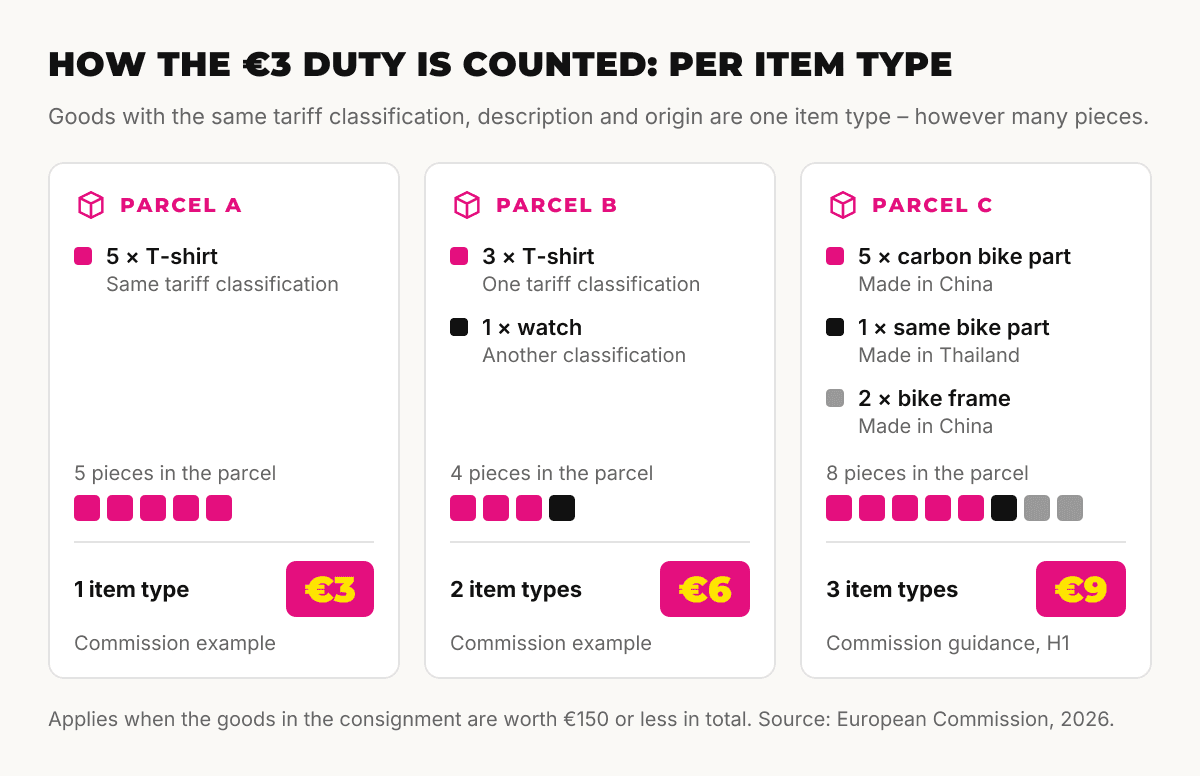
An item type is one or more goods in the same consignment that share the same tariff classification, the same description and – where it is declared – the same origin. In practice the €3 is charged once per line in the customs declaration, however many pieces that line covers.
The Commission's guidance is blunt about it: because of the limits of customs IT systems, the €3 applies automatically per declaration line, irrespective of the quantity on that line, as long as the whole declaration is worth no more than €150. Its explainer of 29 June 2026 gives two examples: five T-shirts cost €3, because all T-shirts share one tariff classification, while three T-shirts and a watch cost €6, because they fall under two.
Worked examples: how many €3 charges?
The customs guidance adds more detailed cases. The bicycle parts show that origin matters as much as the code: the same carbon part made in China and in Thailand becomes two lines.
| Parcel contents (€150 or less in total) | Declaration lines | €3 duty |
|---|---|---|
| 5 T-shirts | 1 – one tariff classification | €3 |
| 3 T-shirts and 1 watch | 2 – two tariff classifications | €6 |
| 5 carbon bicycle parts made in China, 1 identical part made in Thailand, 2 bicycle frames made in China (full H1 declaration) | 3 – same code but two origins, plus a different code for the frames | €9 |
| 3 women's suits in different materials, declared on an H7 or H6 declaration | 1 – the suits share one shorter tariff code | €3 |
| The same 3 suits declared on a full H1 declaration | 3 – three different 10-digit TARIC codes | €9 |
Rows 1 and 2 are from the Commission's explainer of 29 June 2026; rows 3 to 5 are from its customs guidance of 2 June 2026.
Why the declaration type can change the count
Low-value parcels can be declared on three types of import declaration:
- H7 – the reduced data set for distance sales up to €150: a 6-digit HS code, no origin, no quantity. Not allowed for goods subject to prohibitions or restrictions.
- H6 – optional for consignments up to €1,000 without prohibitions, restrictions or excise duties: an 8-digit CN code, no origin.
- H1 – the full declaration: 10-digit TARIC code, origin and quantity. Mandatory for restricted goods, goods subject to excise duty and claims to a preferential duty rate.
The finer the classification, the more lines a parcel can produce. That is why the three suits in the table come to €3 on an H7 or H6 declaration but €9 on an H1. Within these rules, the person lodging the declaration chooses the data set.
Can the lines be merged to pay less?
No. Customs law normally lets a declarant group goods with different tariff codes under the code with the highest duty rate. That simplification is switched off where the €3 duty applies, so each item type stays on its own line.
Myth vs. fact: the €3 duty
| Claim | What the rules say |
|---|---|
| It's €3 per parcel. | It's €3 per item type – per declaration line. A parcel with three different products can cost €9. |
| It's €3 per piece. | Quantity doesn't matter within a line. Five identical T-shirts are one item type and one €3 charge. |
| Sellers using IOSS don't pay it. | It applies whichever VAT scheme is used. IOSS covers VAT only, and all goods imported under IOSS pay the €3. |
| It only hits low-cost platforms in Asia. | It applies to any distance sale shipped from outside the EU – brands in the US, the UK, Canada and Australia included. |
| It replaces import VAT. | VAT is separate. Outside IOSS, the €3 is even added to the amount the import VAT is calculated on. |
| Returned goods get the €3 back automatically. | The import declaration can no longer be invalidated for returned low-value distance sales. Only the general repayment rules remain. |
| Stock sent to an EU warehouse pays €3 per item type. | Genuine stock imported in bulk and cleared before it is sold pays the product's normal duty rate instead. |
Who pays the €3 customs duty?
The declarant pays – in practice the seller or platform, the carrier, or a customs agent declaring the goods for them. The consumer is only a last resort, and only in EU countries that offer individuals a free online customs declaration.
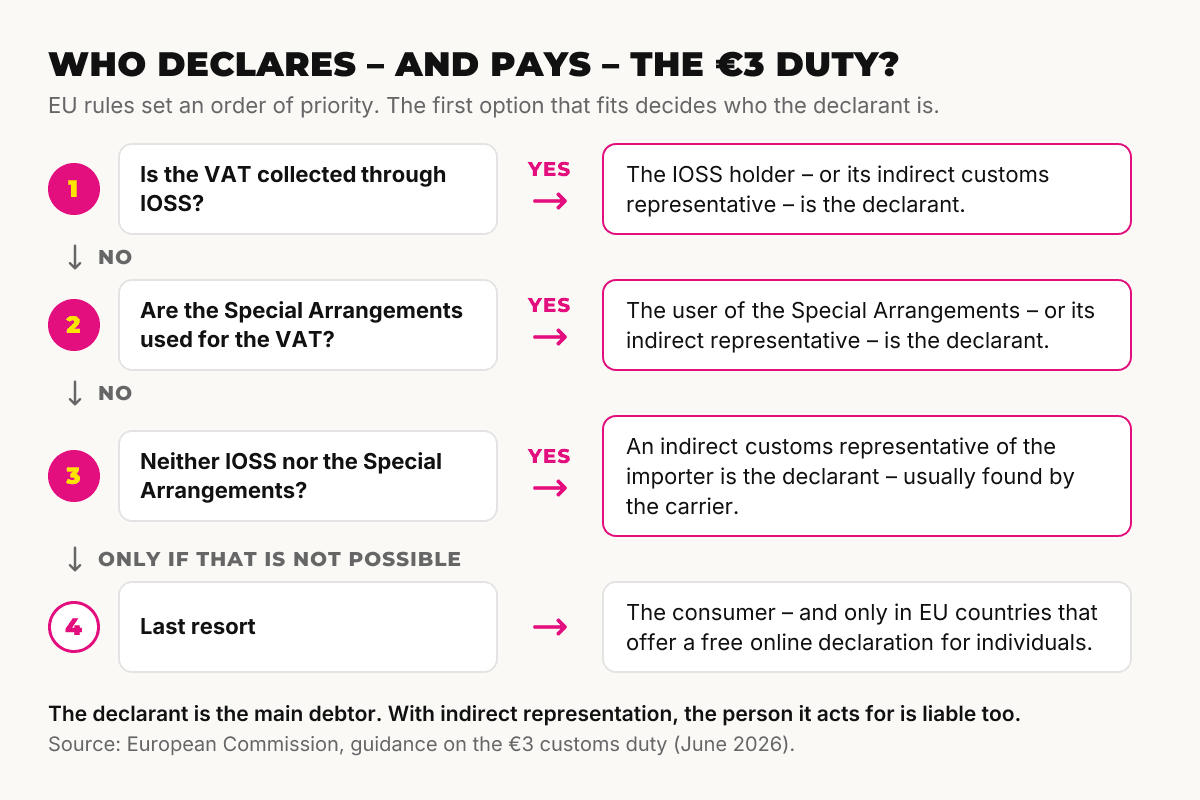
The Commission's guidance says that responsibility for paying the €3 should “first and foremost lie with the declarant, i.e. the platforms, sellers, carrier or agent declaring the goods to the customs authorities”. Who counts as the declarant follows a fixed order of priority:
- IOSS is used: the IOSS holder, or its indirect customs representative.
- The Special Arrangements are used (the carrier collects the import VAT from the customer and pays customs monthly): their user, or its indirect representative.
- Neither applies: an indirect customs representative acting for the importer, normally found by the carrier holding the goods.
- Last resort: the consumer – only in the few EU countries with a free, web-based declaration for individuals outside IOSS.
Why non-EU sellers need an EU representative
A business established outside the EU can't lodge these declarations in its own name – not as IOSS holder, not as Special Arrangements user and not as importer. If you use IOSS, an indirect customs representative in the EU declares the goods in its own name on your behalf. The declarant is the main debtor of the customs debt, and with indirect representation the person it acts for is a debtor too: as the IOSS seller, you stay liable alongside your representative. Without IOSS, the representative acts for the importer, and it is usually the carrier holding the goods that finds one. If the line between a customs broker, a freight forwarder and a 3PL is fuzzy, our role map of who does what in an EU import sorts it out.
In which EU country is the duty paid?
With IOSS, the declaration can be lodged in any EU country, and the customs debt arises there. Without IOSS, the goods must be declared in the country where the delivery ends, so the duty is owed in your customer's country.
Can you pass the €3 on to your customer?
The rules decide who owes the duty to customs, not how you price your products. Whether you absorb the €3 or charge it to your customer is a commercial decision – but under IOSS it has a VAT consequence, explained in the next section.
What changes under the EU customs reform?
The customs reform adopted in September 2026 will make non-EU online sellers and platforms responsible, as importers, for customs on goods they sell directly to EU consumers, phased in over the coming years. Once those provisions apply, the Commission's guidance says, the importer will be the debtor – and for distance sales, the importer is the person supplying the goods or facilitating the sale.
Does the €3 duty apply if I use IOSS?
Yes. IOSS is a VAT scheme and the €3 is a customs duty – all goods imported under IOSS pay it, whichever declaration type is used.
IOSS lets a seller charge the customer's EU VAT at checkout and report it in one monthly return, so no import VAT is charged at the border. It has never covered customs duty. Our guide explains how IOSS works, including the EU-based intermediary that sellers from the US, Canada, Australia and Great Britain generally have to appoint.
If anything, IOSS narrows your options. Goods that qualify for a preferential rate under an EU trade agreement can claim it on a full H1 declaration instead of paying the €3 – but only when the VAT was not collected through IOSS.
Is the €3 part of the import VAT base?
It depends on the VAT scheme. The Commission's VAT guidance on the €3 duty (revised 21 August 2026) sets out three cases:
| VAT scheme | How the VAT is handled | Is the €3 in the VAT base? |
|---|---|---|
| IOSS | No import VAT. The seller charges VAT at checkout and reports it in the monthly IOSS return. | Not at import, and not in the checkout VAT – unless you charge the €3 to your customer at the moment of sale. Then it is part of the price, and VAT is due on it. |
| Special Arrangements | Import VAT is due and the customer is liable. The postal operator or carrier collects it and pays customs monthly. | Yes. The €3 is part of the amount the VAT is calculated on. |
| Standard import VAT procedure | Import VAT is due at import under the normal rules. | Yes. The €3 is part of the amount the VAT is calculated on. |
When goods declared under the Special Arrangements or the standard procedure are returned and the import VAT is refunded, the VAT charged on the €3 is refunded with it.
Is the EU de minimis gone for good?
The duty exemption is gone for good – it was deleted from EU law, not suspended. What is temporary is the flat €3 rate: from 1 July 2028, distance sales of any value are due to pay normal duty rates.
The “EU de minimis” usually meant the customs duty relief for consignments worth up to €150, and Regulation 2026/382 removed it outright. The flat €3 is a bridge until the EU Customs Data Hub can charge normal duties on distance sales, and two review dates are written into the regulation:
- By 1 October 2026, the Commission must assess whether trade flows are being diverted and, if appropriate, propose extending the €3 duty to all goods in consignments of up to €150 – not just distance sales.
- By 1 December 2027, it must assess whether the Data Hub will be operational by 1 July 2028. If not, it may propose keeping the flat duty for longer.
For brands that ship to Europe one parcel at a time, the direction is clear: first a flat duty, then a handling fee, then normal duty rates and – for sellers without IOSS – the import VAT itself. For US brands, we cover why shipping parcels from the US got harder in 2026.
What happens to parcels over €150?
Above €150, the flat duty doesn't apply. The parcel goes through normal EU import clearance: customs duty at the product's normal tariff rate and import VAT at import – and IOSS can't be used.
The normal rate depends on the product's tariff code and origin – where it was made, not where it was shipped from. It is zero for some goods and can be lower for goods that qualify for preferential origin under an EU trade agreement, while some products and origins carry extra duties, such as anti-dumping duties. You can look up your rate in the EU's TARIC database or on Access2Markets.
| What applies | Up to €150 | Over €150 |
|---|---|---|
| Customs duty | €3 per item type (until 1 July 2028) | The normal rate for the tariff code and origin |
| VAT | IOSS at checkout, or import VAT under the Special Arrangements or the standard procedure | Import VAT under the standard procedure – IOSS isn't available |
| Declaration | H7, H6 or H1 | H1, or H6 up to €1,000 where that reduced data set can be used |
| EU handling fee | Due to apply once it takes effect | Due to apply once it takes effect |
Is there an exemption from the €3 duty?
There is no general exemption for low-value parcels sold to EU consumers – that exemption is exactly what was abolished. But the €3 only reaches distance sales of goods that are still outside the EU when they are sold, which leaves three situations outside it.
1. Stock imported in bulk and cleared before it is sold
When stock is imported into the EU in bulk and cleared through customs – released for free circulation – before it is sold, the goods are no longer outside the EU when your customer orders. The orders you then ship from inside the EU are not imports, so neither the flat duty nor IOSS applies. Instead, customs duty at the product's normal rate and import VAT are due once, when the bulk shipment is cleared, and each sale follows the EU's VAT rules for sales within the EU.
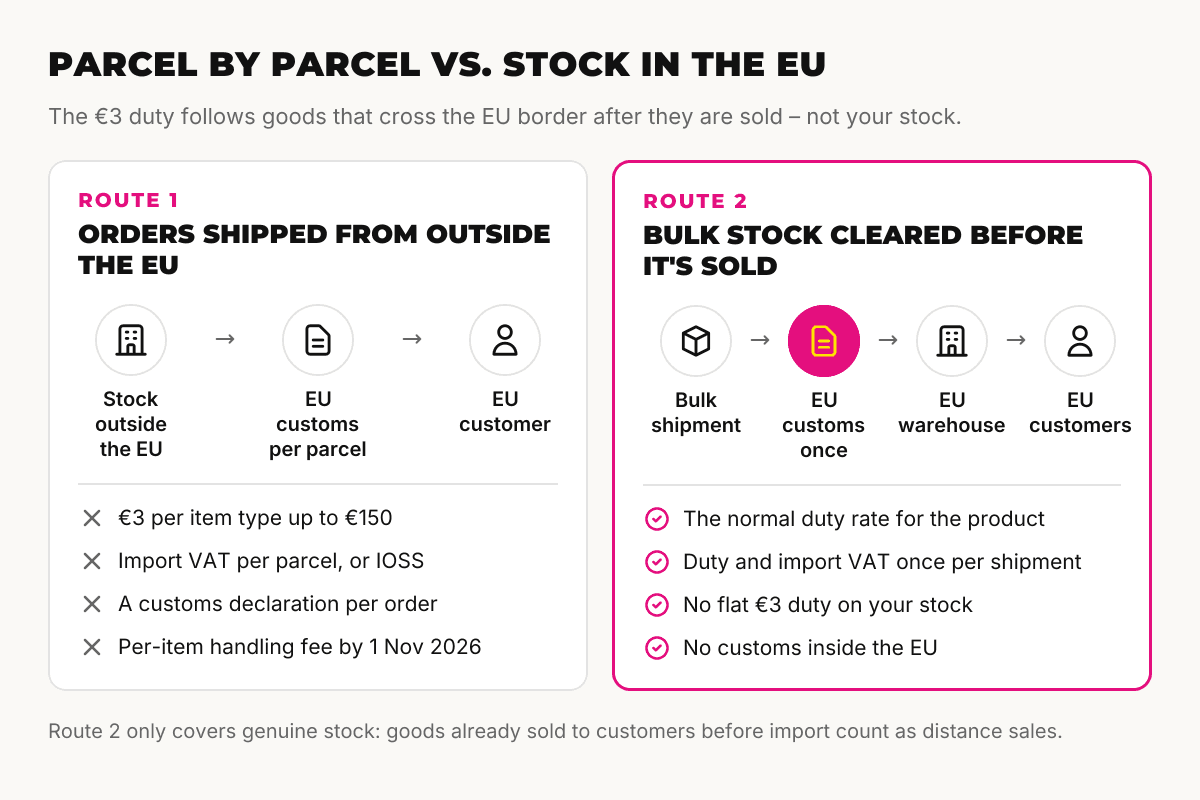
That is the idea behind stocking inventory in the EU. At Primepack in Gothenburg, Sweden, you send your stock in bulk, and we coordinate the customs clearance of your bulk shipment with our customs partners, who can lodge the import declaration on your behalf as your customs agent. Your stock is cleared once, on arrival; after that, we pick, pack and ship each order to customers across the EU with no customs inside the EU.
The honest trade-off is cash flow and setup: duty and import VAT fall due on the whole shipment before you have sold a unit, and you need an EU VAT setup. If you are VAT-registered in Sweden when the goods are cleared, you normally report the import VAT in your Swedish VAT return and deduct it there, to the extent you have a right to deduct.
The catch: goods sold before they are imported
Bulk only counts if it is genuine stock. Goods already sold to individual customers before they enter the EU are distance sales, even if they travel together – and an anti-abuse rule in the Union Customs Code lets customs treat them that way. Signs they look for include individual parcels inside a bulk consignment labeled for different end customers, how often the same operator lodges such declarations, and missing buyer details in a full declaration.
If customs reach that conclusion, they can recalculate the duty at €3 per item type before release, require a guarantee, or invite the declarant to lodge a new declaration – without IOSS. A customs warehouse doesn't change this: goods sold before they are stored there still count as shipped from outside the EU, and goods in one can't be supplied to consumers straight from it. They must be released for free circulation first.
2. Goods with preferential origin, declared without IOSS
Goods that qualify for a preferential duty rate under an EU trade agreement fall outside the flat duty when the VAT is not collected through IOSS: they are declared on a full H1 declaration with the preference claimed. For a UK or Canadian brand selling goods made in its own country, that can mean the Trade and Cooperation Agreement or CETA rate instead of €3 per item type – provided the goods meet the rules of origin and the proof of origin is in order. Whether a carrier will lodge a full declaration for a single parcel is a practical question to settle first.
3. Sales to businesses
Shipments to business customers who account for the import VAT aren't distance sales, so the flat €3 doesn't apply. They don't enter duty-free either: with the €150 relief deleted, such consignments are, as a rule, charged the product's normal duty rate.
What UK brands should know about the €3 duty
Since Brexit, parcels from Great Britain to EU consumers are imports like any other: up to €150, they pay €3 per item type, whether or not you use IOSS. The one way around it is the preferential route above – without IOSS, and only for goods that actually originate in the UK. Goods made elsewhere and shipped from a UK warehouse can't claim the Trade and Cooperation Agreement rate. A GB EORI number isn't valid for EU customs formalities either. The €3 is an EU measure, so it doesn't apply to parcels going into Great Britain. We compare the options in EU fulfillment for UK brands.
What comes next: the handling fee and July 2028
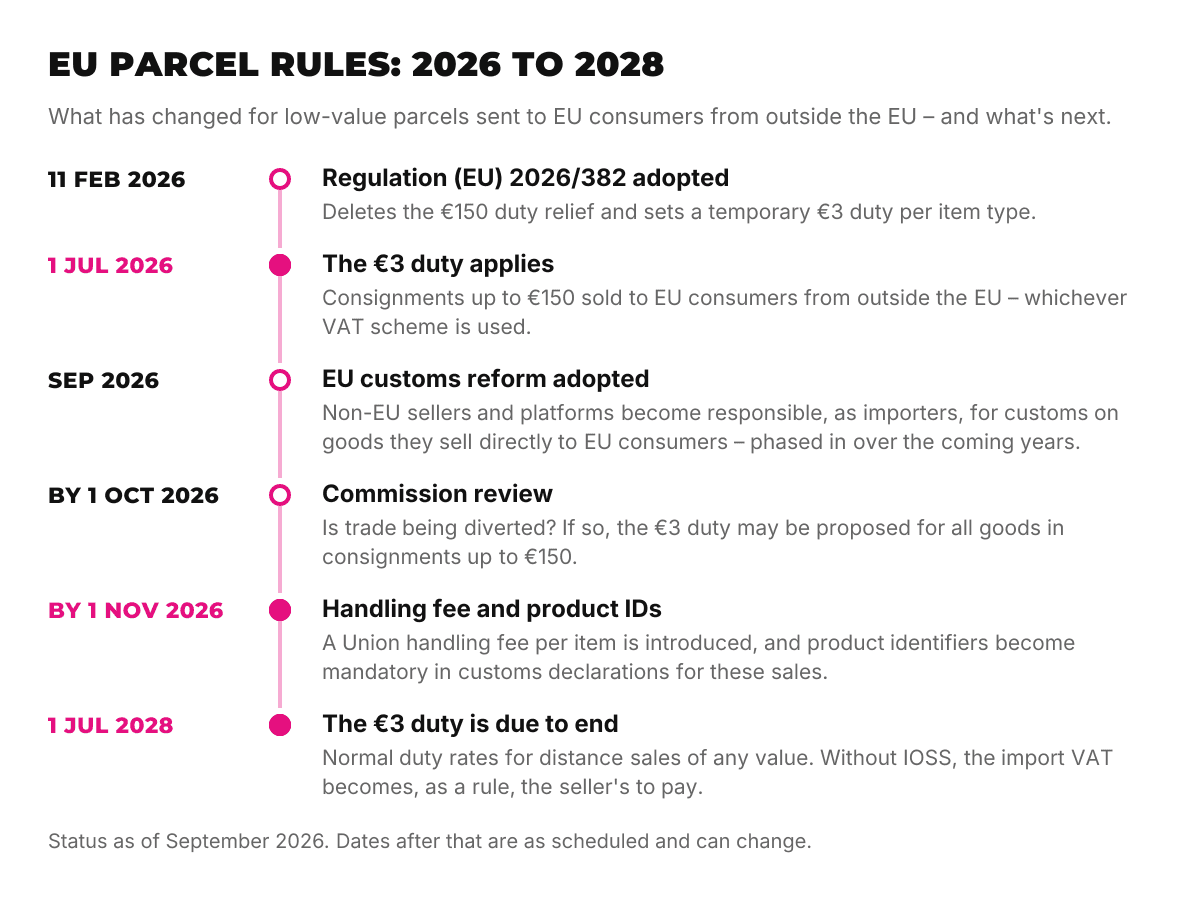
Two changes arrive before the flat duty ends: an EU handling fee per item and mandatory product identifiers in customs declarations. On 1 July 2028, the €3 is due to give way to normal duty rates.
The EU handling fee
According to the Commission's page on the EU customs reform, a Union handling fee on small parcels will be introduced by 1 November 2026 to compensate for the rising cost of customs checks. It is charged per item, and it is a fee, not a customs duty, so it comes on top of the €3 – and unlike the flat duty, it is also due to apply to consignments over €150. The Commission set the amount in September 2026; we don't quote it here because it had not taken effect at the time of writing. The Commission's VAT guidance treats the fee as outside the scope of VAT. Like the €3, it is aimed at goods sold to consumers while they are still outside the EU; genuine stock cleared before it is sold is imported under the normal rules.
Product identifiers from 1 November 2026
From 1 November 2026, declarations for distance sales of imported goods must include product identifiers (voluntary since 1 July 2026): the merchant's product ID as used in the online store or marketplace, the manufacturer's own product ID, and a standardized identifier such as an EAN barcode where one exists. The aim is to let customs apply the result of one inspection to every product that presents a similar risk. If you keep shipping parcels into the EU, make sure your SKUs and barcodes reach whoever lodges your declarations.
1 July 2028: normal duties and import VAT for sellers
From 1 July 2028, goods sold in distance sales are due to pay the normal duty rate for their tariff code, whatever their value, and the EU Customs Data Hub becomes mandatory for e-commerce. Separately, under EU VAT rules adopted in 2025, sellers that ship low-value parcels to EU consumers without IOSS will, as a rule, become liable for the import VAT themselves instead of their customers.
FAQ
Is the 3 euro customs duty charged per parcel or per item?
Per item type. A parcel with five identical T-shirts pays €3; one with three T-shirts and a watch pays €6. What counts is the number of lines in the customs declaration, not the number of pieces or parcels.
Is the €3 customs duty charged on top of VAT?
Yes – it is a customs duty, and VAT is separate. Under the Special Arrangements and the standard procedure, the import VAT is even calculated on an amount that includes the €3. Under IOSS, the €3 isn't part of the checkout VAT unless you charge it to your customer at the time of sale.
Do I get the €3 back if a customer returns the goods?
Not through the usual shortcut. For low-value distance sales, the import declaration can no longer be invalidated when goods are returned after release, so the €3 can't be reimbursed that way – only the Union Customs Code's general repayment rules remain. What your customer is entitled to is a question of EU consumer law, covered in our guide to the EU withdrawal button and returns.
Does the €3 duty apply to parcels from the UK?
Yes. Parcels from Great Britain to EU consumers worth up to €150 pay it like parcels from any other country outside the EU, with or without IOSS. UK-originating goods declared on a full declaration without IOSS may qualify for the zero tariff under the Trade and Cooperation Agreement instead.
Does stock sent to an EU warehouse pay the €3 duty?
Not if it is genuine stock, imported in bulk and released for free circulation before it is sold. It pays the product's normal duty rate and import VAT when the shipment is cleared. Goods already sold to customers before import count as distance sales, even inside a bulk shipment.
When does the €3 customs duty end?
It is scheduled to apply until 1 July 2028, when normal duty rates are due to take over for distance sales of any value. The Commission may propose keeping it longer if the EU Customs Data Hub isn't ready by then.
Weighing up parcels against stock in Sweden? Request a quote and tell us about your products and order volumes.