In short
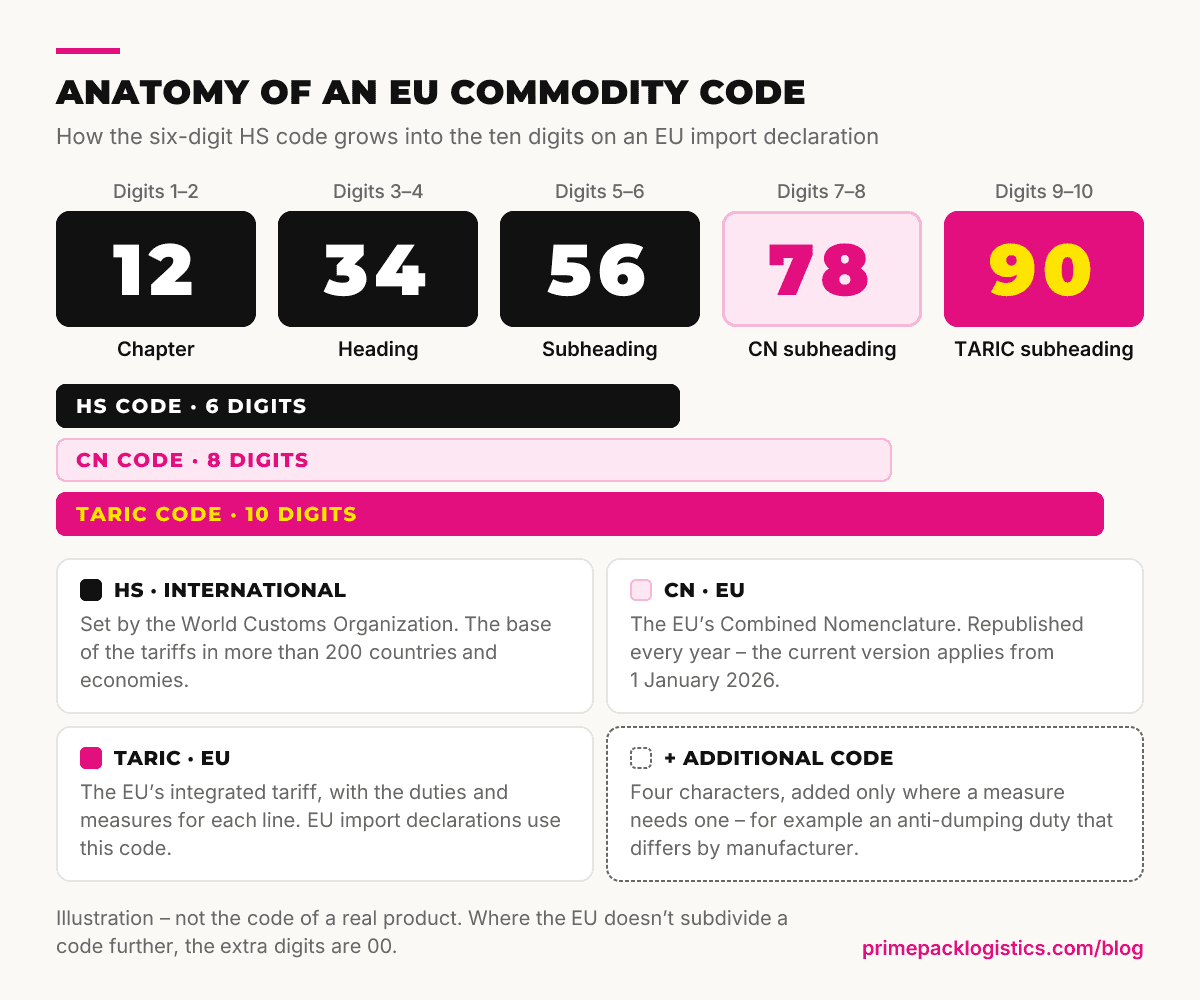
- An EU import declaration uses a ten-digit TARIC code for each product: digits 1–6 are the international HS code, 7–8 the EU's Combined Nomenclature (CN) and 9–10 the TARIC subdivision.
- You can look codes up free of charge in Access2Markets, the EU TARIC database or Swedish Customs' Tulltaxan, but a search only gives you candidates – the classification follows the General Interpretative Rules and the legal notes.
- The code and the goods' origin together decide the duty and any other measures, and a percentage duty is calculated on the customs value, which generally includes shipping and insurance to the EU border.
- The declarant is responsible for declaring the goods correctly, so give your customs agent a precise product description and keep your reasoning on file.
- If you are unsure, a Binding Tariff Information decision gives you a classification that is generally valid for three years throughout the EU.
Your customs agent will ask for the commodity code of every product you send to an EU warehouse. You may already have one from your home tariff or your supplier, but an EU import declaration uses the EU's own ten-digit code – and only the first six digits are international. This guide covers how the codes fit together, where to look them up, how classification works and what to do when you are unsure, as of 4 October 2026.
What is an HS code?
An HS code is the six-digit product code of the Harmonized System, the international goods nomenclature developed by the World Customs Organization (WCO). According to the WCO, more than 200 countries and economies base their customs tariffs and trade statistics on it.
The codes are arranged in 21 sections and 96 chapters. The first two digits are the chapter, the first four the heading and all six the subheading: vacuum flasks, for example, are chapter 96, heading 96.17, subheading 9617.00.
The HS is amended about every five years. HS 2022 has applied since 1 January 2022, and HS 2028 takes effect on 1 January 2028. Most national tariffs build on the same six digits, as Access2Markets notes, so the code in your US, Canadian, UK or Australian tariff is a good starting point – but the digits after the sixth are national and don't carry over to the EU.
HS code vs CN code vs TARIC code: what's the difference?
They are three layers of one code. The HS code is the six-digit international base, the CN code adds two EU digits, and the TARIC code adds two more to make the ten digits an EU import declaration uses.
The CN code: eight digits, updated every year
The Combined Nomenclature (CN) is the EU's goods nomenclature under Council Regulation (EEC) No 2658/87: the HS code plus two digits for EU purposes. The Commission republishes it every year – the 2026 version was published on 31 October 2025 and has applied since 1 January 2026.
The TARIC code: ten digits, plus additional codes
TARIC, the EU's integrated tariff, is a database that brings together all measures linked to the EU's customs tariff and its commercial and agricultural legislation, such as tariff suspensions, quotas and preferences. Digits 9 and 10 split a CN code further where a measure needs it; otherwise they are 00. Some measures add a four-character TARIC additional code – for instance, an anti-dumping duty that depends on which company made the goods. And at import into the EU, the ten-digit TARIC code must be used in customs declarations, as the Commission's Access2Markets FAQ puts it.
| What differs | HS code | CN code | TARIC code |
|---|---|---|---|
| Digits | 6 | 8 | 10, plus a 4-character additional code where a measure needs one |
| Maintained by | World Customs Organization | The EU (Regulation (EEC) No 2658/87) | European Commission (TARIC database) |
| Changes | About every five years – next on 1 January 2028 | Every year – current version since 1 January 2026 | Whenever a measure changes; data goes to EU customs daily |
| Used for | National tariffs in more than 200 countries and economies | Import and export declarations, EU trade statistics | EU import declarations, with each line's duties and measures |
How do you look up a TARIC code?
Use the free official tools: Access2Markets, the EU TARIC database or Swedish Customs' Tulltaxan. Search by product name or by the six-digit code you already have, then work down to the ten-digit line that fits.
- Access2Markets – in My Trade Assistant, enter a product name or code, the origin country and the EU destination. For EU imports, the results show regular and preferential tariff rates, potential trade defence measures, VAT and excise duty, and formalities.
- EU TARIC – browse the nomenclature, or enter a code, an origin and a date to see every measure for that line. It doesn't include national levies such as VAT and excise duty.
- Tulltaxan (Taric) – Swedish Customs' daily-updated search shows the duty and other import charges, and whether you need an import license or special permit.
Treat every hit as a candidate, not an answer: a word like “bottle” matches many lines, and only the legal text and notes decide. Rates and measures change, so check them for the date of your import.
What rules decide how a product is classified?
Its objective characteristics, read through six General Interpretative Rules. Heading texts and the legal section and chapter notes come first; the other rules settle goods that fit more than one heading.
The rules come from the Harmonized System, and the Commission confirms that they and the HS notes form part of the EU's Combined Nomenclature. Classification rests on the goods' objective characteristics – what a product is and how it is made, not what your store calls it.
| Rule | What it says | In practice |
|---|---|---|
| 1 | The heading texts and any section or chapter notes decide; titles are for reference only | A note can include or exclude your product |
| 2(a) | An article's heading also covers it unfinished (if it has the finished article's essential character) and unassembled | A flat-packed product is classified as the assembled article |
| 2(b) | A material's heading also covers mixtures and goods partly made of it; goods of several materials go to Rule 3 | Mixed materials can point to more than one heading |
| 3 | (a) The most specific heading wins; (b) mixtures, composite goods and retail sets go by what gives them their essential character; (c) failing that, the last heading in numerical order | A gift set that Rule 3(a) can't settle goes by the item that gives it its essential character |
| 4 | Goods no rule can place go with the goods they are most akin to | A last resort |
| 5 | Fitted cases and normal packing are classified with the goods, with exceptions such as packing clearly suitable for repeated use | A fitted camera case presented with the camera goes with the camera |
| 6 | Subheadings follow the same rules, comparing only subheadings at the same level | Fix the heading, then go down one level at a time |
Explanatory notes help: the WCO calls its HS Explanatory Notes the official interpretation of the HS at international level, while the Commission's CN explanatory notes are not legally binding. Binding classification decisions also draw on EU classification regulations and rulings of the Court of Justice of the EU.
Does the HS code decide the import duty?
Not on its own. The duty depends on the code and the goods' origin – where they were made, not where they were shipped from. A percentage duty is calculated on the customs value: generally the value of the goods plus shipping and insurance up to the EU border.
Preferential rates only apply when the goods meet the agreement's rules of origin and the right proof of origin is available. Some products and origins carry extra duties, such as anti-dumping duties, and import VAT – plus excise duty on some goods – is charged separately.
| Made in | Position at the EU border | Read more |
|---|---|---|
| United States | No free trade agreement. Since 1 July 2026, 0% duty on many US-origin industrial goods under a time-limited EU regulation, for goods of proven US origin | EU fulfillment for US brands |
| Canada | CETA has removed duties on the vast majority of tariff lines, for goods of Canadian origin with the exporter's origin declaration | CETA and EU fulfillment for Canadian brands |
| United Kingdom | Zero tariffs and zero quotas under the Trade and Cooperation Agreement, for goods that meet its rules of origin | EU fulfillment for UK brands |
| Australia | A free trade agreement concluded in March 2026 was, as of September 2026, not signed or in force, so the standard EU duty applies | EU fulfillment for Australian brands |
Goods made elsewhere and only shipped from one of these countries don't qualify.
Why does the commodity code matter for stock imports?
Because customs treatment follows it. Beyond the duty rate, the Commission lists what else classification is used for: import and export licenses, restrictions, certificates of origin, excise duty and whether a reduced VAT rate applies. For a bulk shipment, your customs agent will typically ask for the commercial invoice, a packing list, the transport document and each product's commodity code, plus proof of origin if you claim a preferential rate.
Who is responsible for the code?
The declarant is responsible for declaring the goods correctly – for a brand outside the EU, typically its EU customs agent, since a business established outside the EU generally can't be the declarant itself. Under indirect representation, both the agent and your business can be held liable for the customs debt, and Swedish Customs can ask for supporting documents after the declaration. So give your agent a precise product description, not just a code. Our guide to who does what in an EU import explains the roles.
At Primepack in Gothenburg, we coordinate the customs clearance of your bulk shipment with our customs partners, who can lodge the import declaration on your behalf as your customs agent.
And for parcels sent from outside the EU?
Since 1 July 2026, parcels worth up to €150 sent directly to EU consumers from outside the EU pay a temporary flat duty of €3 per item type – goods sharing the same tariff line, description and origin – so each additional code in a parcel adds a charge. Stock imported in bulk and cleared before it is sold isn't covered. See what counts as an item type under the €3 duty.
What is Binding Tariff Information (BTI)?
A BTI is a legal decision by an EU customs authority on how one specific product is classified. According to the European Commission, it is generally valid for three years throughout the EU and binds every EU customs administration and the holder.
How do you apply for BTI?
- Apply online, with one application per type of product.
- You need an EORI number. Businesses outside the EU may apply if they have one, in the member state that issued it or where they will use the decision, says the Commission's BTI guidance. Our EORI guide for non-EU businesses explains when and where you get one.
- Describe the product fully: a BTI based on inaccurate or incomplete information is annulled.
- Customs don't charge for issuing it, though they can recover costs such as laboratory analyses. The decision is normally due within 120 days of the application being accepted.
When is BTI worth it?
When the classification is genuinely debatable and the answer matters – for the duty, a trade measure or a product you will import for years. Once you hold one, you must declare it when importing the goods it covers, and it can lapse early if the nomenclature changes or the EU adopts a classification regulation. Other companies' decisions are public in the EBTI database: useful evidence for a similar product, but no guarantee for yours.
How to classify a product for EU customs: a worked example
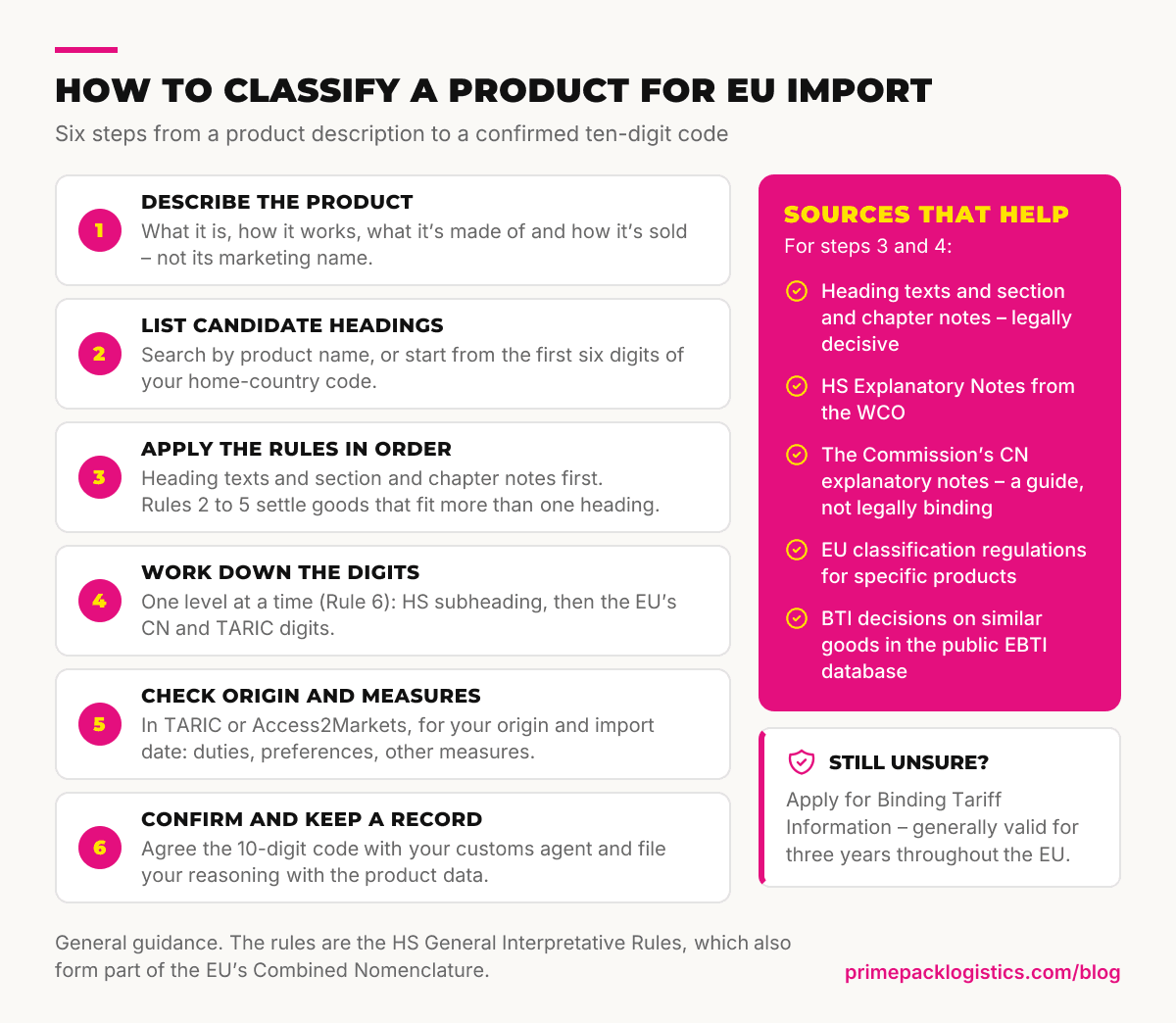
Here are the six steps applied to a fictional product. The brand is invented and we leave out duty rates, but the classification path is real – checked against HS 2022 and TARIC on 4 October 2026.
The product: Harbor & Pine, a fictional Canadian brand, wants to stock its Trailhead bottle in Sweden – a 750 ml drinking bottle with a double stainless-steel wall and a vacuum between the walls, a plastic screw lid and one bottle per retail box, made in Canada.
- Describe it as customs will: a vacuum-insulated drinking bottle, steel body, plastic lid, sold singly, made in Canada. “Trailhead” tells customs nothing.
- List candidate headings. The material points to chapter 73 (articles of iron or steel), where heading 73.23 covers household articles. The function points to heading 96.17: “vacuum flasks and other vacuum vessels, complete”.
- Apply Rule 1. Note 1(m) to Section XV, which contains chapter 73, excludes articles of chapter 96. So a complete vacuum vessel goes to heading 96.17, steel or not: HS subheading 9617.00.
- Work down the digits. The EU doesn't subdivide this heading, so the CN code is 9617 00 00 and the TARIC code 9617 00 00 00. Without the vacuum, you would have started from heading 73.23 – a different code, possibly with a different duty.
- Check origin and measures. Look up the code in TARIC with Canada as the origin. Made in Canada, the bottle can enter at the CETA rate if it meets CETA's rules of origin and the exporter provides an origin declaration – but not if it was made elsewhere and only shipped from Canada.
- Confirm and record. Send your agent the description, code, photos and origin evidence. A percentage duty is calculated on the customs value, with import VAT on top. If your agent sees room for doubt, a BTI settles it.
Real products have details that can change the answer, so treat this as a demonstration of the method, not a ruling on your bottle.
FAQ
Is an HS code the same as a TARIC code?
No. The HS code is the first six digits. The TARIC code is the full ten-digit EU code used on import declarations: the HS code, two CN digits and two TARIC digits.
Can I use my US or Canadian tariff code in the EU?
Only the first six digits, and only as a starting point. The digits after them are national, so look up the EU's CN and TARIC digits separately.
How often do EU commodity codes change?
The CN is republished every year, TARIC can change at any time and the HS itself is amended about every five years – next on 1 January 2028. Check your codes for every new product and whenever the CN changes.
Does the WCO classify products for traders?
No. The WCO says it doesn't give tariff classification advice to private businesses and refers them to the customs administration of the importing or exporting country.
If you are preparing your first bulk shipment to Sweden, ask us for a quote and we'll tell you which documents your customs agent will need.