In short
- Since 13 December 2024, the EU's General Product Safety Regulation (GPSR) has required an economic operator established in the EU to be responsible for each consumer product placed on the EU market.
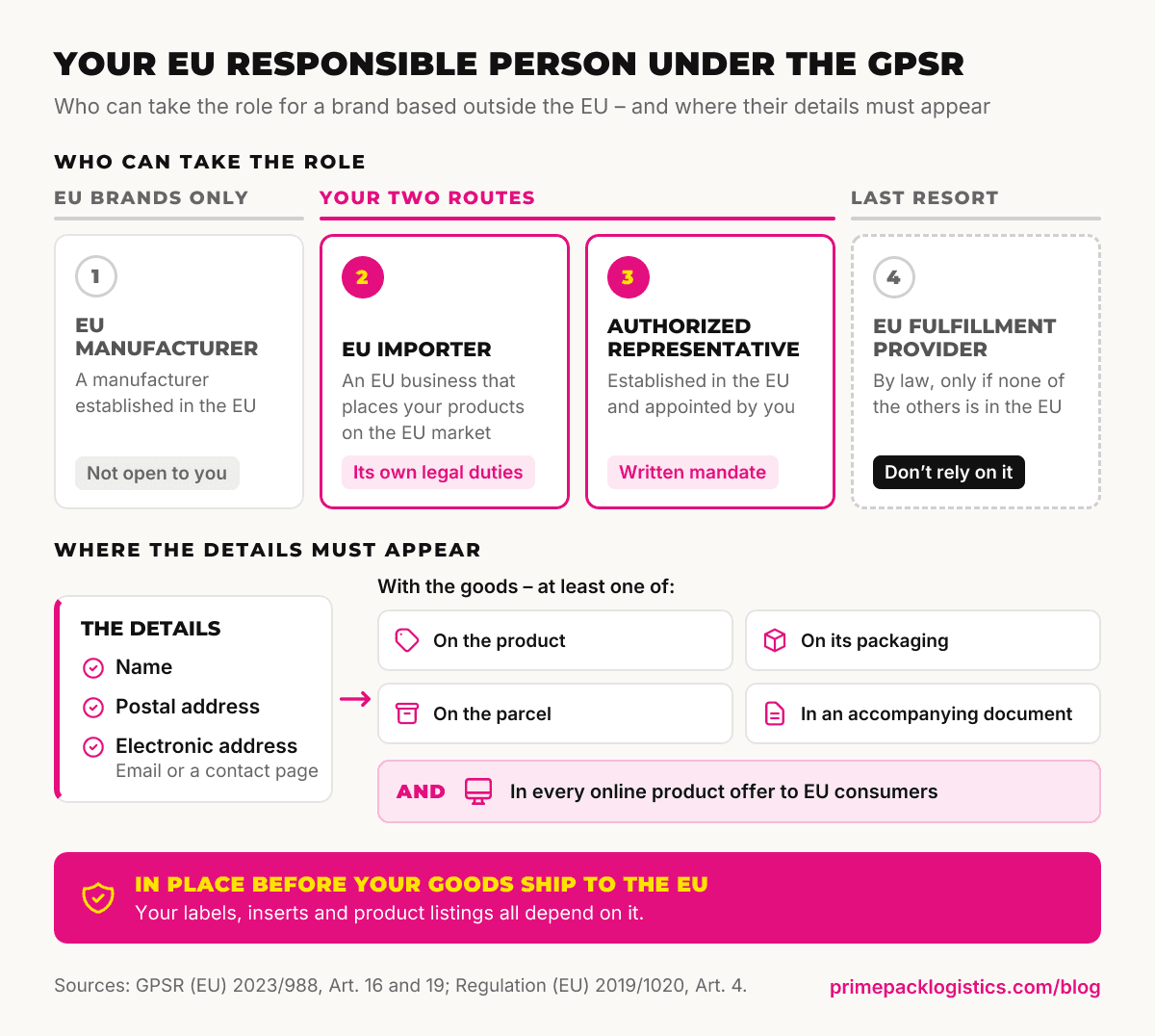
- For a brand based outside the EU, that responsible person is an EU importer or an authorized representative appointed by written mandate.
- Their name, postal address and electronic address must appear on the product, its packaging, the parcel or an accompanying document, and in every online product offer to EU consumers.
- Only where no manufacturer, importer or authorized representative is established in the EU does the role fall, by law, on an EU fulfillment service provider – a fallback, not a plan.
- Put your own responsible person in place before your goods ship to the EU, because your labels and listings depend on it.
If your brand is based in the US, Canada, Australia or the UK and sells to consumers in the EU, the EU responsible person is the compliance role to settle first. Your labels and listings have to name it, so put it in place before your first bulk shipment leaves your supplier.
What is an EU responsible person under the GPSR?
It is an economic operator established in the EU that is responsible for a consumer product placed on the EU market. Under Article 16 of the EU's General Product Safety Regulation (Regulation (EU) 2023/988), a product can only be placed on the EU market if one exists.
Since 13 December 2024, the GPSR has set the baseline safety rules for most consumer products sold in the EU; food, medicines and a few other categories are excluded. Products covered by specific EU legislation, such as toys or electrical goods, must meet those sector rules, and the GPSR covers any risks they don't address. Only products whose EU legislation provides for CE marking may carry the CE mark. The GPSR also covers products offered online to EU consumers by businesses based outside the EU.
Who can be the EU responsible person for a non-EU brand?
An EU importer or an authorized representative that you appoint by written mandate. EU rules set out who acts as a product's EU responsible person:
- a manufacturer established in the EU;
- an importer established in the EU;
- an authorized representative with a written mandate from the manufacturer.
Only where none of these is established in the EU does the role fall, by law, on an EU fulfillment service provider for the products it handles (Market Surveillance Regulation (EU) 2019/1020, Article 4). Your brand is the manufacturer even if a factory makes the goods, because you sell them under your own name or trademark – so the first option is closed to you.
What does an EU responsible person do?
It is the EU contact point for your product's safety, with tasks set by law. Under the Market Surveillance Regulation and the GPSR, it must:
- make sure your technical documentation exists and can be given to the authorities on request, and answer their requests for information;
- tell the authorities if it believes a product presents a risk, and cooperate on corrective action, such as a recall;
- where the risks call for it, regularly check the product against its documentation and labeling;
- make sure accidents it learns of are reported through the EU's Safety Business Gateway.
It is a working role, not just an address on a label.
Importer or authorized representative: how do you set it up?
It depends on who places your products on the EU market. The GPSR defines an importer as a business established in the EU that places a product from outside the EU on the EU market.
Route 1: an EU importer
If an EU-established company buys your goods and sells them in the EU – a distributor or a company in your own group – it is the importer, with duties of its own. It checks your documentation and labeling before selling, and adds its own name and addresses to the product. Don't assume the customs agent that lodges your import declaration is your importer: customs law and product-safety law are separate, as our guide to who does what when you stock inventory in the EU explains.
Route 2: an authorized representative
If your brand stays the seller – shipping to EU consumers from its own stock in an EU warehouse, for example – there may be no importer at all, so check with your advisor. If there isn't one, appoint an authorized representative. Under Article 10 of the GPSR, its written mandate must at least cover supplying information to the authorities, warning you about dangerous products, reporting action taken against risks and cooperating with the authorities. To make it your responsible person, the mandate must also designate it to perform the responsible person's tasks. Whichever route you take, share your technical documentation with them.
Where must the responsible person's details appear?
On the product, its packaging, the parcel or an accompanying document – and in every online product offer to EU consumers. The details are the responsible person's name and contact details, including a postal and an electronic address. According to the Commission's GPSR guidelines for businesses, an electronic address can be an email address or a section of a website where consumers can make direct contact. A website on its own isn't enough.
| Information | On or with the product | In each online product offer |
|---|---|---|
| Your brand as manufacturer: name, postal and electronic address | On the product; if that isn't possible, on the packaging or an accompanying document (Art. 9(6)) | Yes (Art. 19(a)) |
| Your EU responsible person: name, postal and electronic address | On the product, its packaging, the parcel or an accompanying document (Art. 16(3)) | Yes, if you are based outside the EU (Art. 19(b)) |
| Product identification | A type, batch or serial number or other identifier, easily visible and legible (Art. 9(5)) | A picture, the product type and any other identifier (Art. 19(c)) |
| Warnings and safety information | Instructions and safety information in a language consumers can easily understand (Art. 9(7)) | The warnings and safety information that go on or with the product, in that language (Art. 19(d)) |
Each EU country where the product is sold decides that language. In practice it is often the local language; in Sweden, for example, it is Swedish. Check each market's requirements before you print labels, inserts and listings.
Packaging already printed? A label or an insert can carry the details, as long as it doesn't cover information the manufacturer must show. We apply both in bulk as part of kitting, inserts and relabeling; the content and the responsible person are yours.
Can your fulfillment provider be your EU responsible person?
Only as a legal fallback, and you shouldn't rely on it. The GPSR's fulfillment service provider – a business offering at least two of warehousing, packaging, addressing and dispatching without owning the goods, like a typical 3PL – takes on the role by law only if no manufacturer, importer or authorized representative is established in the EU. The Commission's guidelines say it can then become the responsible economic operator automatically.
That fallback keeps someone in the EU answerable; it isn't a plan. Your labels and listings must name your responsible person before you sell, so have your own EU importer or authorized representative in place before your goods are shipped.
Primepack is a 3PL in Gothenburg, Sweden. We don't offer the EU responsible person role, so have your own in place before you ship. See how EU fulfillment for brands outside the EU works, where the responsible person fits in the steps before your first shipment, and our guides to EU VAT, IOSS and EORI.
FAQ
Do I need an EU responsible person if I only sell on my own website?
Yes, if your offer targets EU consumers. The Commission's guidelines name a product page in your own e-shop as an offer that must show the details.
Is an EU responsible person the same as an EU authorized representative?
Not always. An authorized representative is one way to fill the role; an EU importer is the other.
Do UK brands need an EU responsible person?
Yes. A brand based in Great Britain is outside the EU, so it needs an EU importer or an authorized representative, just like a brand from the US, Canada or Australia.
Are EU product rules still changing?
Yes. Rules on online withdrawal functions apply from June 2026 – see our guide to the EU withdrawal button – and a new Toy Safety Regulation, with a digital product passport for toys, will apply from August 2030. Check the current requirements for your product category before you ship.
If you're planning your first shipment to Europe, tell us what you sell and we'll show you how your stock would be received, labeled and shipped from Gothenburg.