In short
- One warehouse inside the EU can serve customers in every member state: once goods are in free circulation, they move between EU countries without customs duties at internal borders, though VAT still applies to each sale.
- A seller based outside the EU with its stock in Sweden normally registers for VAT there and can report sales to consumers in other EU countries through the One-Stop Shop, at each customer's VAT rate from the first sale.
- From our warehouse in Gothenburg, orders typically take 1–2 business days to the Nordic EU countries (Sweden, Denmark, Finland), 2–3 to Germany and Benelux and 3–5 to the rest of the EU.
- A second stock location normally adds a VAT registration and VAT returns in that country, splits your inventory and doubles inbound shipments and returns.
- Several locations can make sense for very large volumes in one country, a next-day promise far from your warehouse or retail customers with strict delivery requirements.
No – for most brands based outside the EU, one EU fulfillment center is enough to sell across the whole EU, even though each EU country sets its own VAT rates. For customs, the EU works as one territory: your stock is cleared once, on arrival, and orders to other EU countries cross no customs border.
Can one warehouse serve the whole EU?
Yes. Goods in free circulation move between EU countries without customs duties at internal borders, and VAT – which still applies to each sale – doesn't require a warehouse in each country.
With all your stock in Sweden, a seller based outside the EU normally registers for VAT in Sweden and reports its Swedish sales there. Sales to consumers in other EU countries can go through the One-Stop Shop (OSS): one return, filed in Sweden, at each customer's VAT rate. The €10,000 distance-selling threshold doesn't apply to sellers established outside the EU, so as a rule the customer's VAT applies from the first sale. The warehouse itself is a 3PL – if the term is new, start with what a 3PL does.
How fast is delivery from one EU warehouse?
From our warehouse in Gothenburg, Sweden, orders typically take 1–2 business days to the Nordic EU countries (Sweden, Denmark, Finland), 2–3 to Germany and Benelux and 3–5 to the rest of the EU. These are typical transit times after dispatch, not guarantees.
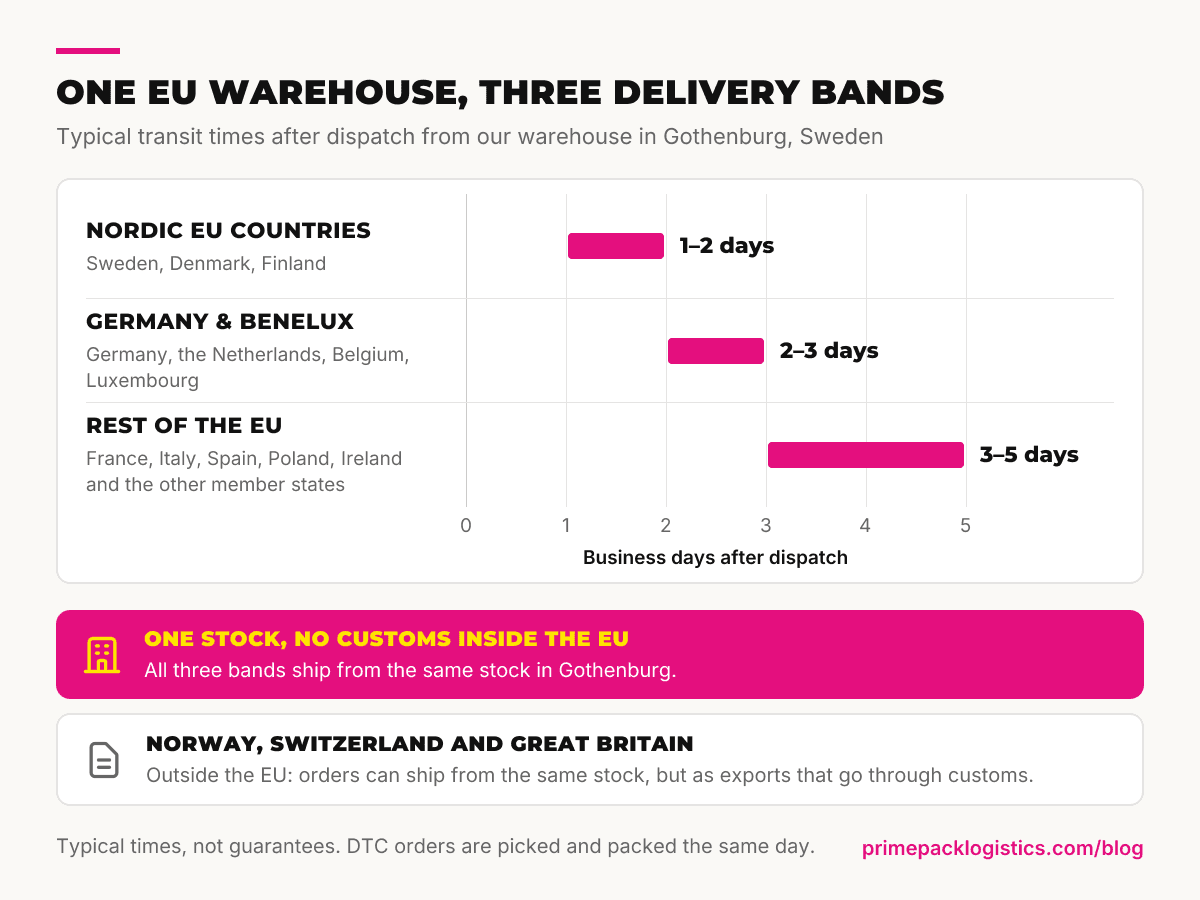
Whether that is fast enough depends on where your customers are. A warehouse in the Netherlands or Germany sits closer to Germany, France and Benelux; Sweden is the stronger base for the Nordics – see where to fulfill in Europe.
What does a second EU warehouse add?
A shorter trip to some customers – plus, normally, another VAT registration, a split inventory and double the flows.
- VAT in a second country. Sales to consumers in the country where the stock is held are domestic sales there, and the European Commission's guide to the One-Stop Shop says they are usually declared in that country's own VAT return, not in the OSS – unless a marketplace is treated as the seller. You also choose which of your stock countries to register for the OSS in, and that choice binds you for the current calendar year and the two following ones.
- Split inventory. A bestseller can sell out in one warehouse while the other still has it – and a restock by sea takes weeks.
- Double flows. Bulk shipments, stock counts and returns per location, each with its own fees – see how our pricing is built.
| What changes | One EU warehouse | Several EU warehouses |
|---|---|---|
| Customs between EU countries | None once your stock is cleared | None – the same |
| VAT | A registration where the stock is, plus the One-Stop Shop | Normally a registration and returns in each stock country, plus the One-Stop Shop |
| Inventory | One stock to forecast | Split stock, each with its own buffer |
| Delivery time | Depends on each country's band | Can be shorter where you add stock |
| Returns | One EU return address | Several, unless routed to one |
When do several EU warehouses make sense?
When one market is big enough, or demanding enough, to justify its own stock:
- Very large volume in one country. If one country takes a large share of your orders, stock near those customers shortens the trip for most of your parcels.
- A next-day promise far from your warehouse. If you promise next-day delivery in a country that sits in a slower band, you need stock in or near it.
- Retail customers with strict requirements. Large retail and wholesale customers may set delivery windows or lead times that are easier to meet from stock in their country.
You don't have to decide on day one: start with one location and add a second when the numbers in one market justify it.
What about Norway, Switzerland and Great Britain?
They are outside the EU customs union and the EU VAT area, so no EU warehouse changes their status. Orders there can ship from the same stock, but as exports that go through customs – see EU delivery times and export markets.
FAQ
Do I need a VAT number in every EU country I sell to?
Not if you use the One-Stop Shop. With your stock in Sweden, you register for VAT there and can report sales to consumers in other EU countries in one OSS return.
Do my EU customers pay customs duty on their orders?
No. Duty and import VAT are due once, when your bulk shipment is cleared, and orders shipped to EU customers from that stock involve no customs. This holds for genuine stock: goods already sold to customers before import don't count.
Can I move stock to a second EU warehouse later?
Yes. Goods in free circulation move between EU countries without customs duties. Check the VAT consequences with your tax advisor before you move stock.
Weighing one EU warehouse against several? Send us your orders by country and we'll tell you how far one stock in Gothenburg takes you.