In short
- Sweden, Denmark and Finland are EU member states inside the customs union and the VAT area; Norway is outside both, so orders shipped there from an EU warehouse are exports that go through customs.
- Finland uses the euro and Sweden, Denmark and Norway the krona and krone (SEK, DKK and NOK); standard VAT is 25% everywhere except Finland, at 25.5%.
- In 2025, 91% of internet users in Denmark and 90% in Sweden bought online, against 78% across the EU, according to Eurostat – and cards are the most common way to pay online in all four countries.
- EU product rules generally require instructions and safety information in a language consumers can easily understand, as decided by each EU country where the product is sold – in practice often the local language.
- From stock in Gothenburg, orders typically reach Sweden, Denmark and Finland in 1–2 business days, and Danish and Finnish consumer sales can be reported through the One-Stop Shop in Sweden.
Selling to the Nordics usually means four countries: Sweden, Denmark, Finland and Norway. From the US, Canada, Australia or the UK they can look like one region – close neighbors with some of Europe's most active online shoppers – but the setup differs country by country. This guide compares them on EU status, currency, VAT, language, payments and delivery.
How do Sweden, Denmark, Finland and Norway compare?
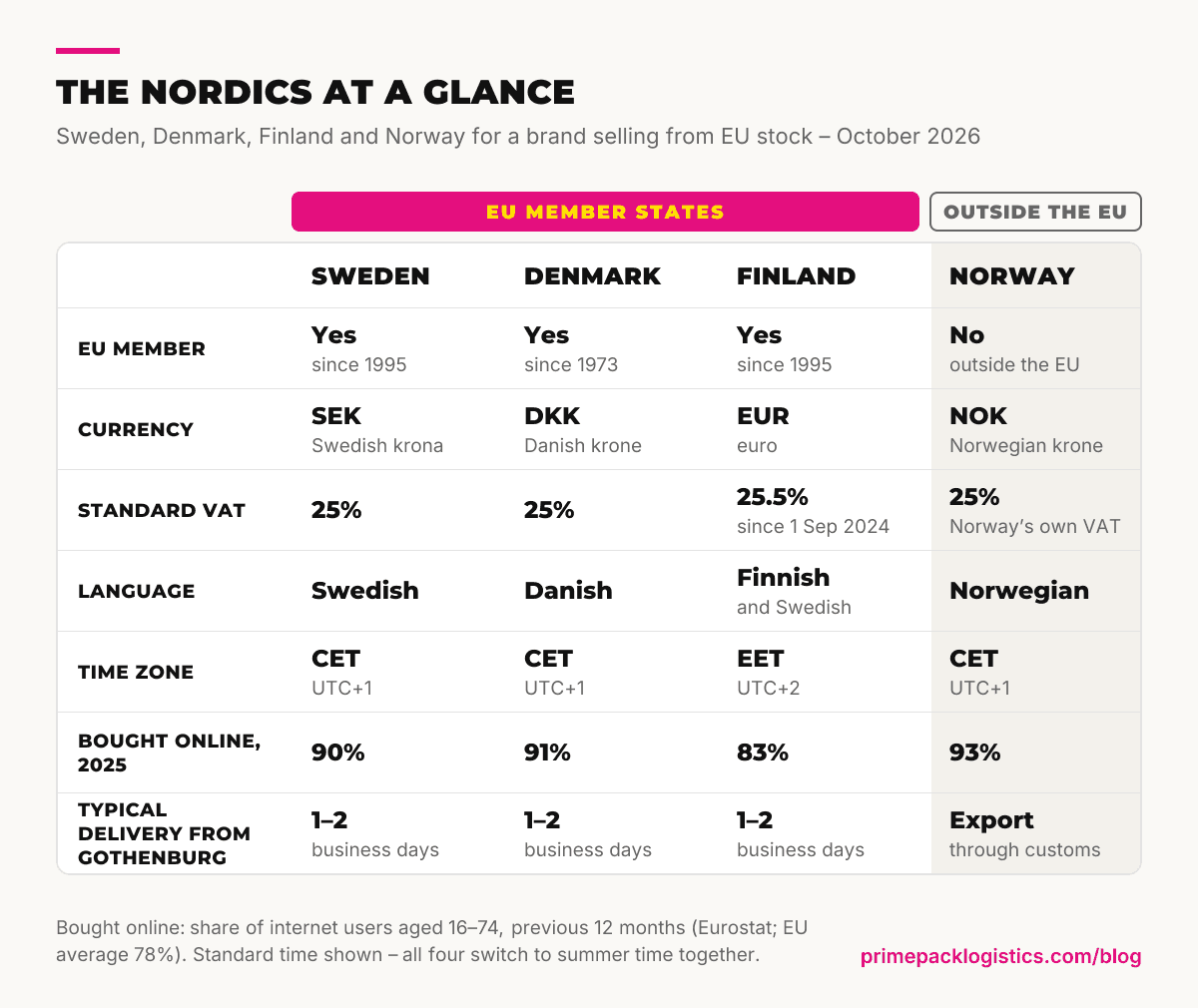
Three things set them apart: EU membership, currency and language. VAT rates are almost the same – 25% everywhere except Finland, at 25.5%.
Which Nordic countries are in the EU?
Sweden, Denmark and Finland are EU member states; Norway is not. Denmark joined in 1973, Sweden and Finland in 1995.
That line decides your logistics. The three EU countries are inside the EU customs union and VAT area: once your stock is cleared into the EU, orders to Swedish, Danish and Finnish customers involve no customs. Norway is outside both, so orders shipped there from an EU warehouse are exports and go through customs – even from Sweden next door. They can still ship from the same stock.
How big is the Nordic e-commerce market?
Small in population, big in online shopping. The four countries have almost 28 million people between them – about 10.6 million in Sweden, 6.0 million in Denmark and 5.6 million each in Finland and Norway on 1 January 2025, according to a joint report by the Nordic central banks. Iceland, the fifth Nordic country, has about 0.4 million.
A large share of them buy online. In 2025, according to Eurostat, 91% of internet users in Denmark and 90% in Sweden had bought goods or services online in the previous 12 months – in the EU, only Ireland and the Netherlands were higher – against an EU average of 78%. Norway was at 93% and Finland at 83%. You don't need a warehouse in each country to reach them; see whether you need a warehouse in every EU country.
What currencies do the Nordic countries use?
Finland uses the euro; Sweden, Denmark and Norway use the Swedish krona (SEK), the Danish krone (DKK) and the Norwegian krone (NOK). Finland is the only Nordic country in the euro area. Sweden has no target date for adopting the euro, and Denmark has an opt-out and keeps the krone within narrow margins of the euro.
For pricing, that means four currencies. Decide early whether you set a price in each one or convert from a base price; the European Central Bank's daily reference rates cover SEK, DKK and NOK. Our post on Sweden, the euro and the krona explains what the krona means when your warehouse is in Sweden.
How does VAT work when you sell to the Nordics?
Each sale to an EU consumer carries the VAT of the customer's country: 25% in Sweden and Denmark, 25.5% in Finland. Finland's standard rate rose from 24% on 1 September 2024; all three EU rates are listed on Your Europe. Norway's standard rate is also 25%, but Norway is outside the EU VAT area.
With your stock in Sweden, a business based outside the EU normally registers for VAT in Sweden and charges Swedish VAT on Swedish sales. Brands from the US, Canada, Australia or the UK should also plan for a VAT agent approved by the Swedish Tax Agency, and confirm it with the agency or a tax advisor. Sales to consumers in Denmark and Finland can go through the One-Stop Shop: one return, filed in Sweden, at the Danish or Finnish rate – from the first sale, because the €10,000 threshold doesn't apply to sellers established outside the EU. Our guide to EU VAT for non-EU sellers covers each step.
| Customer in | Standard VAT rate | Reported in | Customs |
|---|---|---|---|
| Sweden | 25% Swedish VAT | Your Swedish VAT return | None |
| Denmark | 25% Danish VAT | One-Stop Shop return, filed in Sweden | None inside the EU |
| Finland | 25.5% Finnish VAT | One-Stop Shop return, filed in Sweden | None inside the EU |
| Norway | Norway's own VAT (25%), outside the EU VAT area | Not the One-Stop Shop – ask your tax advisor | Export – goes through customs |
Prices shown to EU consumers must include VAT: the Price Indication Directive defines the selling price as the final price including VAT and all other taxes. So Finland's higher rate means a slightly higher price there or a slightly lower margin. See how to set VAT-inclusive prices per market in Shopify.
Can you sell to the Nordics in English?
Partly – but plan on local languages for product information. English is widely spoken in Sweden: about nine in ten people say they can hold a conversation in it (Special Eurobarometer, 2024). But EU product rules generally require instructions and safety information in a language consumers can easily understand, as decided by each EU country where the product is sold. In practice this is often the local language – in Sweden, Swedish.
Finland has two official languages, Finnish and Swedish, but 85% of Finns speak Finnish as their native language and 5% Swedish. Norway's national language is Norwegian. Check each country's requirements before you print labels, inserts and listings, and use the same list for your storefront translations.
How do Nordic shoppers pay online?
Mostly by card – with a local twist in each country. In their December 2025 report, the Nordic central banks found physical cards the most common way to pay online, by number of payments, in all four countries – though their share is falling. Cards stored in mobile phones are also common in Norway, Finland and Denmark, while in Sweden a large share of online payments are bank transfers made with Swish.
Swish in Sweden, MobilePay in Denmark and Vipps in Norway are widely adopted, bank-owned mobile payment apps; their success has been strongest in payments between people and, to some extent, in e-commerce. In Sweden, the Riksbank's 2026 payments report names Swish and ‘buy now, pay later’ services as the single most common methods for online purchases, although card payments of all kinds still add up to 64% of the methods used. Check which of these your platform and payment provider support in each country.
How fast can you deliver to Nordic customers?
From our warehouse in Gothenburg, orders typically take 1–2 business days to the Nordic EU countries (Sweden, Denmark, Finland), 2–3 to Germany and Benelux and 3–5 to the rest of the EU. DTC orders are picked and packed the same day. Norway can be served from the same stock, but those orders are exports and go through customs.
Time zones line up too. Sweden is on Central European Time, usually six hours ahead of the US East Coast; Denmark and Norway keep the same time, and Finland is one hour ahead. Our team works in English on CET, with a dedicated contact person for your account – see how US brands work across the time difference. If the Nordics are a real market for you, Sweden is a natural base; our comparison of where to fulfill in Europe shows when the Netherlands or Germany fits better.
FAQ
Is Norway in the EU?
No. Norway is outside the EU customs union and the EU VAT area, so orders shipped there from an EU warehouse are exports and go through customs.
Does Finland use the euro?
Yes – it is the only Nordic country in the euro area. Sweden, Denmark and Norway use the krona (SEK) and the krone (DKK and NOK).
What is the VAT rate in the Nordic countries?
The standard rate is 25% in Sweden, Denmark and Norway and 25.5% in Finland. Some goods have lower rates, so check the rate for each product.
Do I need a VAT registration in Denmark and Finland?
Not if you use the One-Stop Shop. With your stock in Sweden, you report Danish and Finnish consumer sales in one return filed in Sweden. Without it, you would normally register in each country.
Planning a Nordic launch? Tell us which countries you want to reach, and we'll show you how one stock in Gothenburg can serve them.